
By Liora R. Halperin
It’s hard enough for a community to negotiate its own collective memory of historical violence. What is worthy of remembering? Whose stories should be told? It is exponentially more challenging when multiple communities’ histories of violence intersect and overlap and raise questions of relative victimization, the uniqueness or non-uniqueness of historical crimes, and the ways victims’ quest for justice can facilitate or impede other communities’ quests for the same.
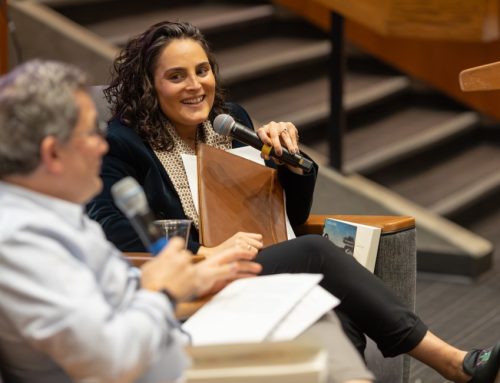
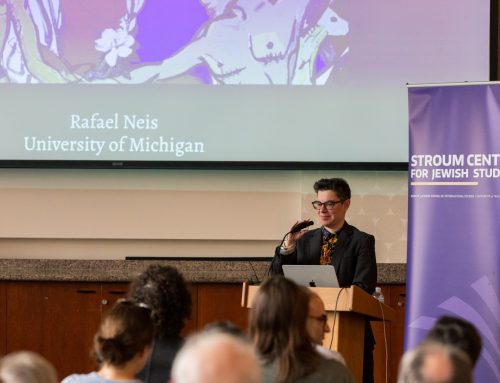
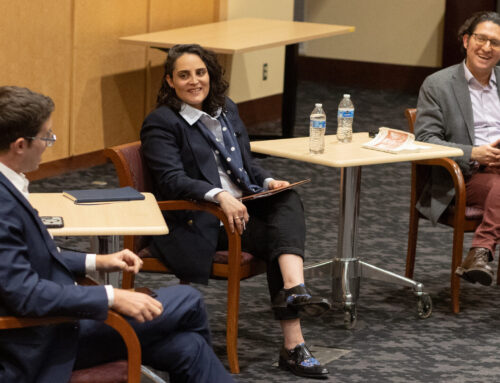
During his March 2025 visit to the University of Washington, Professor Ari Joskowicz of Vanderbilt University presented his research into a fraught and fascinating example of relational memory: the ways that Jewish and Romani Holocaust memory has been and remains intertwined. Roma, also known as Romani, Sinti, or, pejoratively, as “Gypsies), are a transnational group long located on the social and economic margins of Europe. An estimated 500,000 Roma and Sinti were murdered by the Nazis in the Holocaust, sometimes in the same camps as some of the almost 6 million Jewish victims. Whereas the Jewish quest for commemoration and recognition has been highly visible, the Romani experience has remained in the shadows. Yet Roma have become deeply intertwined with Jewish institutions of memory as Jewish archives, museums, and legal processes also, along the way, gathered evidence of the murder of Roma. Romani organizations have also modeled their advocacy along the lines of Jewish advocacy, leading sometimes to successful recognition, and other times to Jewish gatekeeping and efforts to limit Holocaust memorialization to the Jewish experience.
During a lunchtime workshop with graduate students, Prof. Joskowicz spoke more broadly about the ethical dilemmas of memory, commemoration, and the politics of having one’s stories told, particularly in the era of the internet and digital media. What happens when the products of efforts to be heard (testimonies, videos) become tools of a surveillance state to listen in. How are the effects of such surveillance unequally distributed across contemporary communities? He also told us about his new work on the financial side of Holocaust commemoration: though it can be hard to talk about, it takes money to create and preserve archives, to fund and maintain public and private Holocaust memorials, and to engage in research projects. How does funding, its sources, or its absence, constrain and shape the forms remembrance takes?
Prof. Joskowicz’s visit kicked off what will be an exciting and thought-provoking yearlong series of inquiry into the thorny questions of relational memory by the new UW Simpson Center for the Humanities Interdisciplinary Cluster on this topic, led by SCJS faculty Liora Halperin (JSIS and History) and Jason Groves (German). In November, the Simpson Center will welcome, as Katz Distinguished Lecturer, Michael Rothberg of UCLA. Prof. Rothberg is a leader in the Memory Studies field with his work on “multidirectional memory” and Holocaust memory in the post-colonial era, particularly in Germany, who has become a ground zero in debates about the legacy of the Holocaust, antisemitism, Islamophobia, and immigration. In Winter 2026, we will welcome Prof. Brahim El-Guabli (Johns Hopkins) to speak about his work on Jewish and Amazigh (indigenous Moroccan) memory in Morocco. Finally, in Spring 2026, we will welcome Prof. Simone Stirner of Harvard, to speak on queer memory after National Socialism.