Photo credit: UW Daily
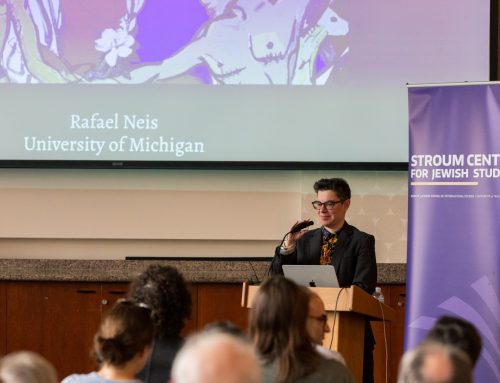
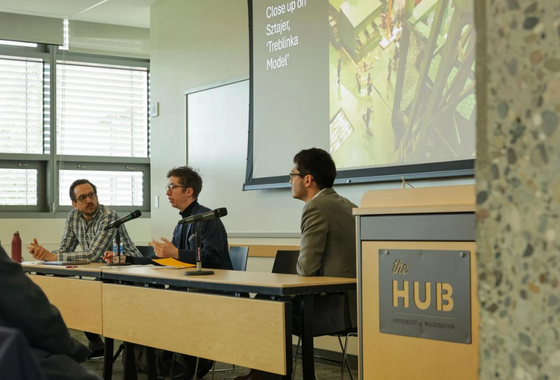
What is believed to be the first–ever U.S.–based symposium focusing on the impact AI has on Holocaust studies was held at the UW in May. SCJS and iSchool faculty Ben Lee organized the three-day symposium with the United States Holocaust Memorial Museum and brought together more than a dozen experts from around the world to engage in cutting-edge conversations. The first two days were spent behind closed doors sharing research and learnings. On the third day, the public was invited to a daylong series of panels that ended in a roundtable discussion with UW faculty. After the event, we caught up with Lee to share his thoughts on the symposium.
Q: In a few words, what were the key highlights of the AI and the Holocaust workshops and symposium?
Lee: For me, the key highlight of the three days was bringing together experts from across disciplines to learn from each other and expand our understanding of the topics posed. The two days of closed sessions provided a rare opportunity to take deep dives into various dimensions of our research and collectively work through details – I learned an enormous amount. Lastly, the questions raised by audience members during the public symposium were particularly inspiring, demonstrating such thoughtful and substantive engagement with the questions at the heart of the programming. They touched on topics ranging from the perils of incorporating AI in Holocaust education to the opportunities and challenges of developing AI methodologies for improving discoverability in archives.
Q: What new information did you learn that excites (or surprised) you the most?
Lee: I was particularly excited about the pedagogical opportunities that colleagues and I discussed over the course of three days. Projects that apply AI in the context of Holocaust research and memory are themselves such valuable opportunities for teaching, from helping students to develop AI literacy to developing critical lenses surrounding when applications of AI are not appropriate, as they relate to the limits of representation. I am inspired by my colleagues and am excited by the possibilities of bringing these approaches into the courses that I teach in the Information School.
Q: What guidance would you give the general public about the impact of AI on Holocaust information they may see? What guidance would you give educators who teach about the Holocaust?
Lee: For both the general public and educators, I would encourage people to take a step back and ask: why is AI being used in this context? On the one hand, applications of AI such as handwriting transcription have the capacity to unlock archives. On the other hand, AI chatbots in the style of Anne Frank are problematic for many reasons. Asking why AI is being used, and who the technology serves, is a great first step in understanding impacts we may see – and for educators to understand what to use in the classroom.
Q: Thinking about the future, five years from now, what changes do you foresee related to Holocaust studies and AI?
Lee: I anticipate that the emphasis of applying AI in the context of Holocaust research and memory will only continue to grow – for better and for worse. One of the outcomes of this workshop and public symposium will be a whitepaper that my colleagues and I hope to write together, which we hope will continue to generate discussion among scholars and practitioners across disciplines. Five years from now, I hope that we are able to look back and see this event, as well as the whitepaper, as a place for cultivating conversations that remain relevant.