

Stroum Lectures 2026 with Rafael Neis
Tuesday, May 12, 7:00 pm PDT - 9:00 pm PDT
The Stroum Center for Jewish Studies is proud to announce our 2026 Samuel and Althea Stroum Lecture series, featuring Professor Rafael Neis from the University of Michigan.
Both events are free and open to all. Please register here: Registration Required
Lecture 1: Did ‘Men’ and ‘Women’ Always Exist? What the Talmud Can Tell Us
May 12, 7:00-9:00pm, Kane Hall, Walker-Ames Room 225
We often assume that the categories “man” and “woman” are timeless and self-evident. But what if they aren’t? In this talk, Professor Rafael Neis invites us to explore a surprising question: did “men” and “women,” as fixed and stable categories, always exist in the way we imagine them today? Turning to the Talmud, Neis shows how the rabbis wrestled with bodies, identity, and social roles in ways that don’t always fit neatly into modern assumptions. By setting aside what we think we already know about gender, we can discover fresh and unexpected ways of reading these ancient texts—and gain insight into how the rabbis themselves understood human difference. Along the way, Neis opens up intriguing new perspectives on rabbinic thought, revealing a tradition that is more curious, complex, and inventive than we might expect. Please join us for an informal reception following the lecture.
Lecture 2: Monsters, Hybrids, and Holy Images – Rethinking Bodies in Ancient Jewish Art
May 14, 4:00-5:30pm, HUB, 214
Walk through the ancient world and you would have been surrounded by images of all kinds of beings—human figures, animals, hybrids, and creatures that blur the line between the familiar and the fantastic. These images appeared everywhere: in streets and homes, bathhouses and synagogues, public buildings and sacred spaces. In this talk, Professor Rafael Neis explores a handful of striking examples from ancient Jewish art and asks what happens when we look at them with fresh eyes. Instead of sorting these figures into modern boxes about “human,” “animal,” “male,” or “female,” Neis invites us to step back and see how ancient artists and communities imagined bodies more broadly. By letting go of some of our present-day assumptions, we begin to notice new patterns and possibilities—and gain insight into how people in the ancient world understood identity, difference, and the sacred. The result is a richer, more surprising picture of Jewish visual culture, filled with creativity, complexity, and imagination.
About the Speaker
Rafael Neis is a scholar and artist. Neis is the Jean and Samuel Frankel Professor of Rabbinic Literature and is appointed in the Department of History and Frankel Center for Judaic Studies at the University of Michigan. As Faculty Director of Arts Learning at Michigan’s Arts initiative, Neis supports campus-wide art-integrated pedagogy. Their second book, When a Human Gives Birth to a Raven: Rabbis & the Reproduction of Species, was published in 2023 by University of California Press. Their artwork has been featured in shows and in many publications.
The Stroum Lectures in Jewish Studies is a nationally-renowned series of public lectures, which has brought Jewish studies luminaries from around the globe to the University of Washington for more than fifty years. Made possible through the support of the Samuel and Althea Stroum Lectures Endowment, this annual series is a cornerstone program of UW’s Stroum Center for Jewish Studies and has led to impactful conversations, groundbreaking scholarship, and award-winning publications. You may view the full Stroum Lectures archive here and review corresponding books published by University of Washington Press here.
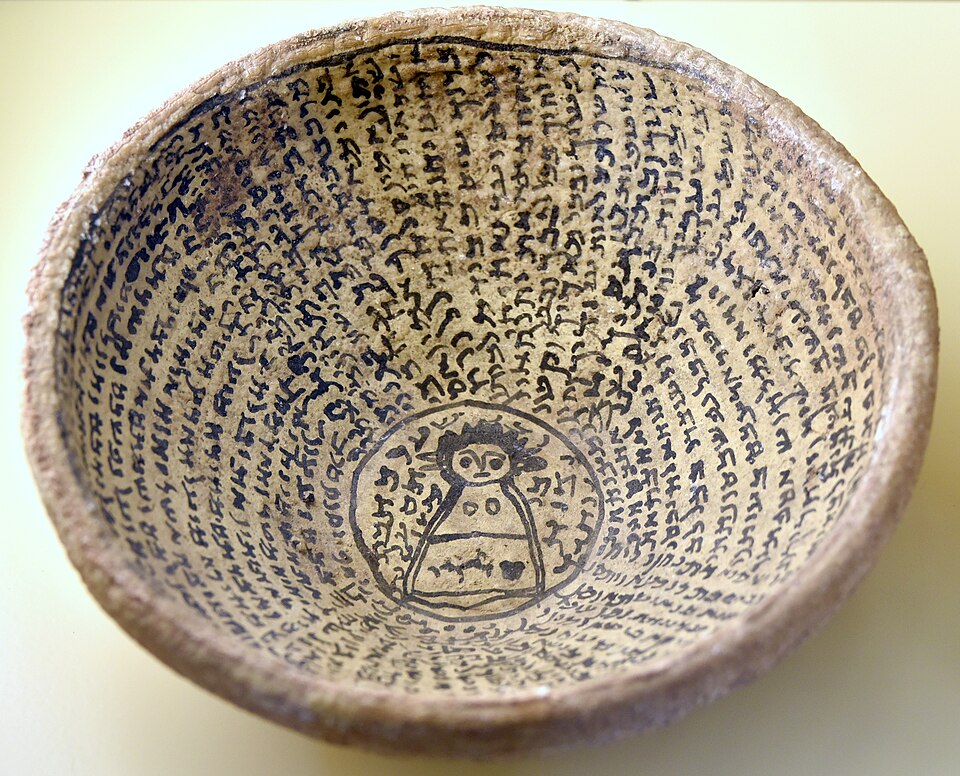
Image: 4th-7th c. incantation bowl written in Aramaic from Iraq. Photo by Osama Shukir Muhammed Amin via Wikimedia Commons.