

Stroum Lectures 2027 | “Popular Jews” with Saul Zaritt
Tuesday, May 18, 2027, 6:30 pm PDT - 8:00 pm PDT
The Stroum Center for Jewish Studies is proud to announce our 2027 Samuel and Althea Stroum Lecture series, featuring Saul Zaritt from Ohio State University.
Both events are free and open to all. Registration links to be posted soon.
Lecture 1: Jews and Jewishness in the Popular Imagination
Date: Tuesday, May 18, 6:30 – 8:00 pm
Location: Seattle Campus
Why is it that Jews and discussions of Jewishness appear with such frequency and prominence in popular culture of the twentieth and the twenty-first century? From Hollywood empires to news headlines and viral videos, Jews and Jewishness have taken a seemingly disproportionate place among the identities and stereotypes portrayed in popular media. This lecture discusses the history of popular culture and the role Jewishness has played and continues to play in its construction. The transformations of the nineteenth and twentieth centuries—rapid urbanization, population expansion, industrialization, the consequences of empire and colonization, the onrush of new technologies and forms of mass media—led to dramatic changes in the very idea of the public sphere. Within this mess of change, Jews played varied and complex roles, as sometimes idealized “figures of modernity,” but also oft-maligned predatory outsiders, celebrated innovators but also demonized blasphemers, threatening yet familiar almost-citizens. This lecture considers several examples of Jews and Jewishness in popular culture, from famed Jews like Albert Einstein and Sigmund Freud to antisemitic and philosemitic fantasies of Jewish power, arguing that how a society imagines the figure of the Jew reflects its understanding of modernity and shifting ideas of citizenship, personhood, and gender.
Lecture 2: Whose Body? A Jew’s Body: Jews in Popular Fiction of the Twentieth and Twenty-first Century
Date: Thursday, May 20, 4:30 – 6:00 pm
Location: Seattle Campus
This lecture considers a century of popular fiction, from the golden age of detective fiction (1920s and 30s) to contemporary “romantasy” novels, asking why these genres, which for the most part are not overtly about Jews or Jewish topics, still end up making repeated, if veiled, references to Jewishness. Why did the victim in Dorothy Sayer’s first murder-mystery, Whose Body (1923), have to be a Jew? Why is J.R.R. Tolkien’s The Lord of the Rings (1954-55) so deeply concerned with notions of race, with special representation of Jews throughout? These two examples are often considered foundational to their respective genres, detective fiction and fantasy, and each evinces seemingly ready-made systems of race and ethnicity. Contemporary examples in the wildly popular genre of romantasy, from Sarah J. Maas to Rebecca Yarros, reproduce and update these representations for the present moment. The figure of the Jew becomes a cypher for forms of social categorization and stratification, that, alongside ideas of Blackness and other notions of the other, continue to undergird the popular imagination today.
About the Speaker
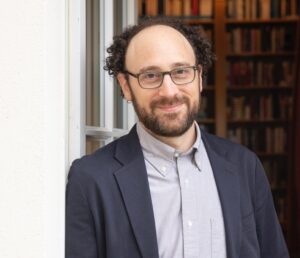
Saul Noam Zaritt is assistant professor of Yiddish language and Ashkenazic culture at The Ohio State University. He is the author of two books: Jewish American Writing and World Literature: Maybe to Millions, Maybe to Nobody (Oxford University Press, 2020) and A TaytshManifesto: Yiddish, Translation, and the Making of Modern Jewish Culture (Fordham University Press, 2024). A founding editor of In geveb: A Journal of Yiddish Studies (ingeveb.org), he has recently launched the website shund.org, a database of popular Yiddish fiction. Saul’s research has been supported by fellowships at the YIVO Institute for Jewish Research, the Frankel Institute for Advanced Judaic Studies at the University of Michigan, and the Center for Jewish Studies at Harvard University; in fall 2025 he was a Charles Haimoff fellow and Berlin Prize winner at the American Academy in Berlin.