

Sephardic amulets (kame’ot), from the collection of Rabbi Solomon Maimon.
Summary
- Sepharadim throughout the Ottoman world shared a belief in demons, known in Hebrew and Ladino as shedim and danyadores, respectively.
- People were particularly wary of demons during pregnancy.
- Sepharadim kept the demons at bay with a variety of folk practices, such as kame’ot, or amulets.
- Folk practices became far less common as more Sepharadim immigrated to the United States.
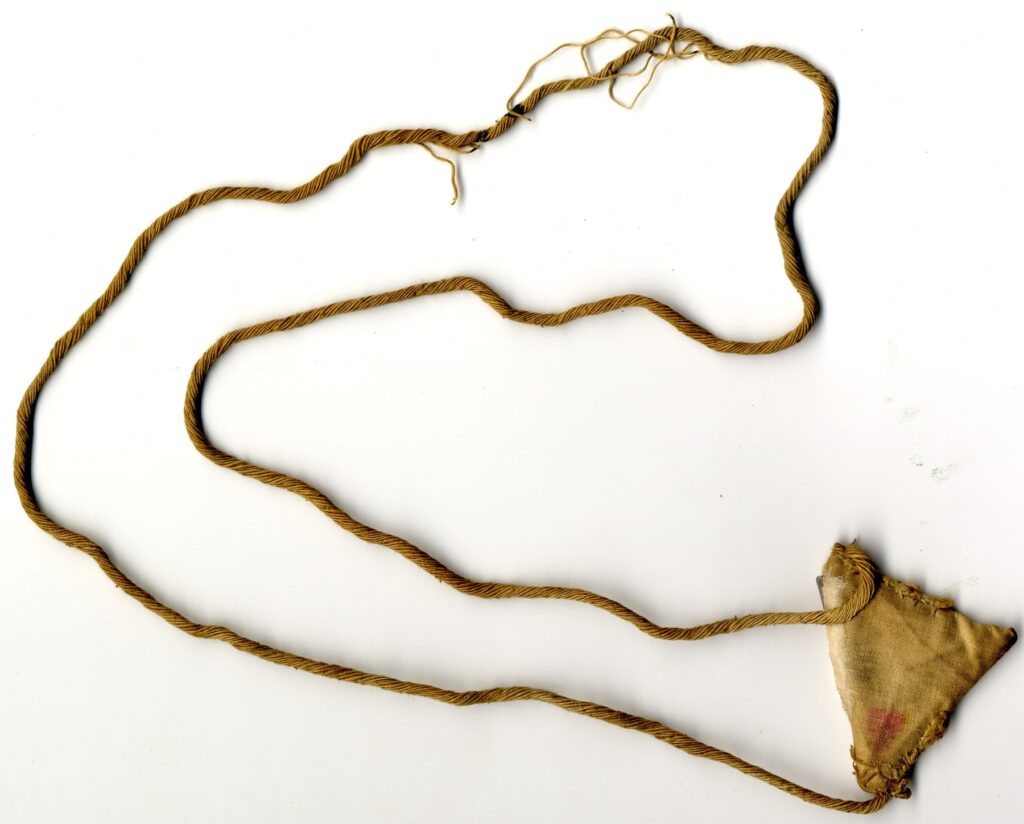
Naar family kame’a from Salonica, meant to be worn around the neck.
Throughout the Ottoman world, rabbis engaged in a variety of practices relating to kame’ot. In one tradition, scribes would write out shadayim — two paper kame’ot inscribed with the names of angels and that of the demon Lilith, who was believed to be notorious for harming newborns. The mother would pin one of the shadayim to herself and the other onto her baby to protect themselves from Lilith. Since Lilith purportedly had wings, many times the kame’ot would be fashioned with wing shapes, as well.3
Kame’ot in the Old World
In Salonica and other towns throughout the Ottoman Empire, scribes often composed kame’ot with elaborate mystical formulas that invoked the names of angels, called upon to protect the newborn. Written on long, rectangular pieces of parchment or fabric, and then folded up into a small triangle package resembling a savory Sephardic pastry known as a fila, the kame’a would accompany the newborn wherever he or she went, including into adulthood. The kame’a would sometimes be sewn shut, attached to a string, and worn around the neck, or slipped into a wallet.

Rabbi Benjamin Naar’s kame’a.
In his engaging memoir, one of the great Ladino journalists and novelists of the twentieth century, Elia Carmona, from Istanbul, attributed his professional success and fame to the kame’a he carried with him since birth. He believed the amulet enabled him to overcome all the obstacles life threw at him.
Kame’ot in the New World
Many of the kame’ot from the Sephardic Studies Digital Collection were preserved by Avraham Maimon, who came from Tekirdag (a town near Istanbul) to Seattle in 1924 to serve as a rabbi. He preserved several kame’ot in various scripts, but it remains unclear whether he himself composed them.
If Rabbi Maimon did compose these amulets, it seems that he eventually disregarded the harmful spirits of the old world when he immigrated to the United States: His son Bension recalls Rabbi Maimon saying, “As far as Seattle is concerned, we shouldn’t worry, because these [demons] didn’t cross the Atlantic Ocean.”4
Other Sepharadim who immigrated to the United States did not readily dismiss the possibility that the demons followed them to their new homes. Professor Devin Naar’s great-grandfather, Rabbi Benjamin Naar, a practitioner of kabbalah, composed kame’ot in the Salonican fashion described above both in his native city, and even after he immigrated to the United States with his family in 1924.
Unlike for Rabbi Maimon and the Seattle community, for Rabbi Naar and his communities in New York and New Jersey, the practice of composing kame’ot continued for another generation — even into the immediate post-World War II years. Some of Rabbi Naar’s descendants and other community members still possess their kame’ot today.
From this perspective, it would seem that demons may have indeed crossed the Atlantic Ocean — but perhaps they did not succeed in making the train ride all the way to the Pacific Northwest.
References
1. Molho, Michael. Alfred A. Zara, trans., Robert Bedford, ed. Traditions and Customs of the Sephardic Jews of Salonica. New York: Foundation for the Advancement of Sephardic Studies and Culture, 1994. pg. 47.
2. Levy, Isaac Jack, Rosemary Zumwalt. Ritual Medical Lore of Sephardic Women: Sweetening the Spirits, Healing the Sick. Chicago: University of Illinois Press, 2001. pg. 97.
3. Gaguine, Shem Tov. Keter Shem Tov. Ramsgate, England, 1934. Reprint, Jerusalem: Israel, 1998. Section 34:766.
4. Maimon, Bension. Albert S. Maimon and Eugene Norman, eds. The Beauty of Sephardic Life: Scholarly, Humorous & Personal Reflections. Seattle: MaimonIdeas Publishing, 1993. pg. 188.