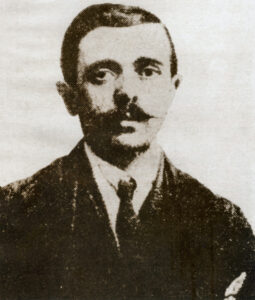
Portrait of Avraham Benaroya,
Wikimedia Commons
By Alexandra Ritsatos
For much of the twentieth century, Greek political culture erased left-wing activism on the one hand, while popular memory erased the presence of major Jewish communities, on the other. As a result, we have very little historical documentation of politically active Greek Jews, especially their first hand accounts. There are, however, two important exceptions, the cases of Avraam Benaroya, 1887-1979, and Michael Moissis Bourlas, 1918-2011. While the two men were members of different generations, their writing offers unique glimpses into the lives of Greek Jews in the twentieth century. And their literary contribution to the history of the Greek left is important as the authors claim space as important political actors of the tumultuous Greek twentieth century.
In the first decades of the twentieth century, some working class Salonikan Jews were at the forefront of left-wing and communist activism in Salonika. Salonika, now known as Thessaloniki in Northern Greece, was an important late-Ottoman port city that at its height had a Jewish plurality and was the site of political exploration and participation not just among Jews but among the city’s Muslim and Eastern Orthodox residents as well. Salonikan Jews specifically played a crucial role in the early socialist organizing of the city that took place during the late-Ottoman period. After the annexation of the city by the Greek Army in 1912, while the city itself underwent radical demographic and spatial transformation, Salonikan Jews remained politically active in the socialist, communist, and labor movements. In my graduate research, I investigate the ways in which the Greek state viewed the involvement of minorities on the political Left with great suspicion. This suspicion resulted in the repression and policing of anything labeled as socialist and communist.
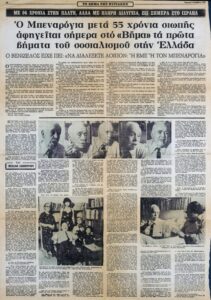
Article page from the newspaper To Vima in November of 1978 following the publication of Benaroya’s book and the interest it caused. According to the main caption, he positions himself as a direct adversary of the politician Eleftherios Venizelos and recounts the story of early Greek socialism.
The Jewish-majority federationalist socialist organization, Federasion Sosialista Lavoradera, sought to build ties between the working classes of different ethnoreligious communities, and was at the forefront not only of late-Ottoman but also Greek organizing for the betterment of working conditions in Salonika. Avraam Benaroya was an activist, organizer, and founder of the Federasion. In 1931, Benaroya published The First Stages of the Greek Proletariat, which was republished decades later in 1975 following Greek democratization in 1974. The title of his book suggests that Benaroya saw himself as an important player in an imagined Greek working-class struggle. His republication in the 1970s highlights his desire for a renewed memory toward the end of his life; he sought for his political participation to be recognized and remembered. The conditions themselves had changed after 1974, when democratization came with a promise for a better life across the political spectrum.
Benaroya was a key leader of the Federasion and played an important role in the founding of the Socialist Workers’ Party of Greece in 1918, later renamed the Communist Party of Greece in 1924. While political differences distanced him from the Party after 1924, the unique traces of life he left behind resulted in his labeling as founder of Greek communism. Benaroya’s book shows that the early history of the Greek left had deep roots in Ottoman radicalism and Salonikan Jewish history.
The political realities of post-war Greece and the Greek Civil War led Greek Jewish Holocaust survivors who had been active in the Greek Left to silence and erase their past. As such, the memoirs of Avraam Benaroya and Michael Moissis Bourlas stand out in the reconstruction of Greek Jewish left-wing history after decades of silence. Bourlas’ story is particularly unique, Bourlas joined the Youth of the Communist Party of Greece (OKNE) in 1935 and remained loyal to the Party for over a decade. He fought in the Greek Army at the outbreak of the Greek-Italian War in 1940 and later joined the communist-aligned armed resistance forces (ELAS). His political involvement in OKNE and ELAS labeled him a ‘dangerous citizen’ and led to his imprisonment after 1945.[1] Just a few decades earlier, Benaroya was also one of the first two citizens which the Greek state determined to be dangerous and exiled to the island Naxos. The Greek state exercised on Benaroya for the first time a practice of imprisonment and internal exile that later became its primary way of controlling and criminalizing political dissent.
Bourlas would be freed from prison only in 1951 under the conditions of renouncing his Greek citizenship and migrating to the state of Israel where he stayed until 1967 before migrating to the Soviet Union. Bourlas’ decision to migrate to the USSR in 1967 is particularly unique and surprising since 1967 was also the same year that the Soviet government applied its policy of refusenik which barred Jews and others from leaving the country. In the 1990s, he moved back to Greece and fought to regain his lost citizenship. Bourlas published his book titled, Greek, Jewish and Leftist in 2000 where he recounts his life story. He died in Greece in 2011 after leading a tumultuous life and deep commitment to his political beliefs. Bourlas’ life was definitely unique, however his experiences showcase the dilemmas faced by Greek Jews and Greek Christians on the left during the Greek twentieth century. Let me explain.
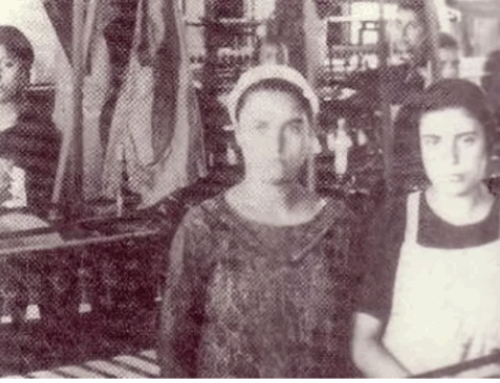
In the interwar period, the Greek- and Ladino-language press of the time, irrespective of political affiliation, depicted a city defined by widespread poverty and labor struggles. The destructive fire of 1917, the unprecedented influx of Greek and Armenian Orthodox refugees from Asia Minor, the 1929 Financial Crash and the marginalization of Salonika in an Athens-centered economy resulted in the deep impoverishment of the city’s interethnic working classes. By the middle of the 1930s, anxieties of poverty were prominent when discussing the future of Salonika, and its impoverished population, both Christian and Jewish.
The impoverished people in the city found themselves greatly vulnerable to extreme weather conditions, including flooding as a result of significant rainfall. An article published in the Greek language newspaper Makedonia from early May 1936 titled “Torrential Rain Caused Significant Damage in the Districts of Thessaloniki and the Surrounding Settlements; Many Remain Unhoused” highlights the instability of life for poor working class people in this city. Most importantly, the article reports on the destruction of housing in the neighborhood of Ampelokipoi, a central neighborhood where Greek and Armenian Christians and Jews lived together. This common sense of vulnerability contributed to the interreligious alliances in the left of this time period.
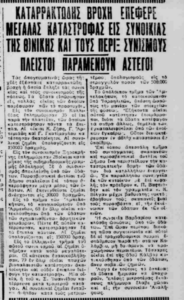
The article, titled “Torrential Rain Caused Significant Damage in the Districts of Thessaloniki and the Surrounding Settlements; Many Remain Unhoused” which discusses the flooding in the poor neighborhoods of Salonika.
Makedonia, May 6th, 1936
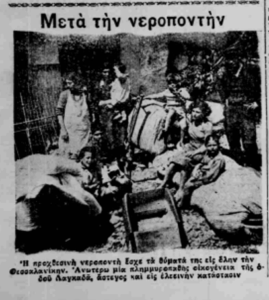
Picture published in the newspaper Makedonia of a family whose home was destroyed by the flood.
Makedonia, May 7th, 1936.
The Nazi occupation and the Holocaust in Greece decimated Greek Jewish communities across the country, including the largest Jewish community of Salonika. The vast majority of working class Jews who had been active in the communist and labor movements were murdered at Auschwitz-Birkenau. One of the many results of the violent destruction of Jewish Salonika was the silencing and erasure of the memory of an interreligious and interethnic left that was present in the city in previous decades.
The Holocaust and also the dynamics of the Greek civil war – an armed conflict between the state-backed Army of Greece and the communist-backed Democratic Army of Greece (1946-49) – resulted in a strong repression of anything that could in any way be labeled as leftist or communist. This repression not only affected the political rights of communists, but also a broad demographic of people who challenged the illiberalism of a violent anti-communist state. The consequences of the Greek civil war greatly criminalized and repressed mentions and memories of the political left at large and especially among Salonikan Jews who found themselves in the margins of belonging. They were at once non-Christians in an illiberal and Christian-identifying nation-state and survivors within decimated communities. For that reason, the few Holocaust survivors residing in Greece repressed any memories of participation in the left that they had been part of. This was nothing but a survival mechanism in an unfriendly country which was undergoing deep divisions and repression.
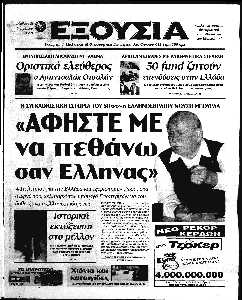
Frontpage newspaper report of Moissis Bourlas where he expresses his yearning to be allowed to die as a Greek.
Exousia, November 21st, 1998
In the last few decades of the twentieth century in Greece, there was a great number of both scholarly and popular publications recounting the story of the Greek leftist twentieth century. Many prominent Greek leftists published books and memoirs about their experiences following decades of marginalization. Very few Jews, however, were represented in this story. The books of Benaroya and Bourlas both stand out and at the same time fit into these stories. Because of this destruction and silence, the memoirs of Avraam Benaroya and Michael Moissis Bourlas stand out in the reconstruction of Greek Jewish left-wing history after decades of silence. While writing this article I could not avoid stopping and wondering what do the existing stories and first-hand perspectives tell us or hide from us about Greek Jewish experiences on the political left?
[1] The term ‘dangerous citizens’ comes from anthropologist Neni Panourgiá’s book and illustrates the ways in which Greek leftists faced repression during the mid-to-late twentieth century, as a result of being viewed as ‘dangerous’ for the nation. Here is the link to Panourgia’s book:https://fordhampress.com/dangerous-citizens-hb-9780823229673.html
For more information on the treatment of political prisoners and the early post-World War II anti-communist state see historian Polymeris Voglis’ book, Becoming a Subject; Political Prisoners during the Greek Civil War, 1945-1950: https://www.berghahnbooks.com/title/VoglisBecoming
 Alexandra Ritsatos is a third-year Ph.D. student in history at the University of Washington. Her research delves into the dynamics of working-class Jewish Salonika with a particular interest in the relational dynamics that were present in the labor and leftist movements of the city. Alexandra is particularly interested in examining the political activism of working-class Salonikan Jewish men and women as well as their non-Jewish neighbors and the political visions they put forth within the context of their changing city following its annexation by the Greek nation-state from the Ottoman empire. For her Ph.D. dissertation, Alexandra hopes to explore political activism and belonging among marginalized groups in Salonika and examine the dynamics between Sephardic Jews, refugees from Asia Minor and Armenians, in the interwar Greek communist left.