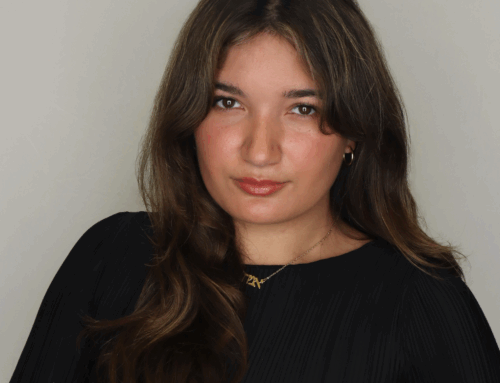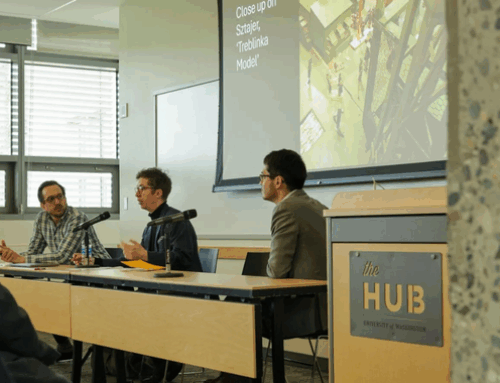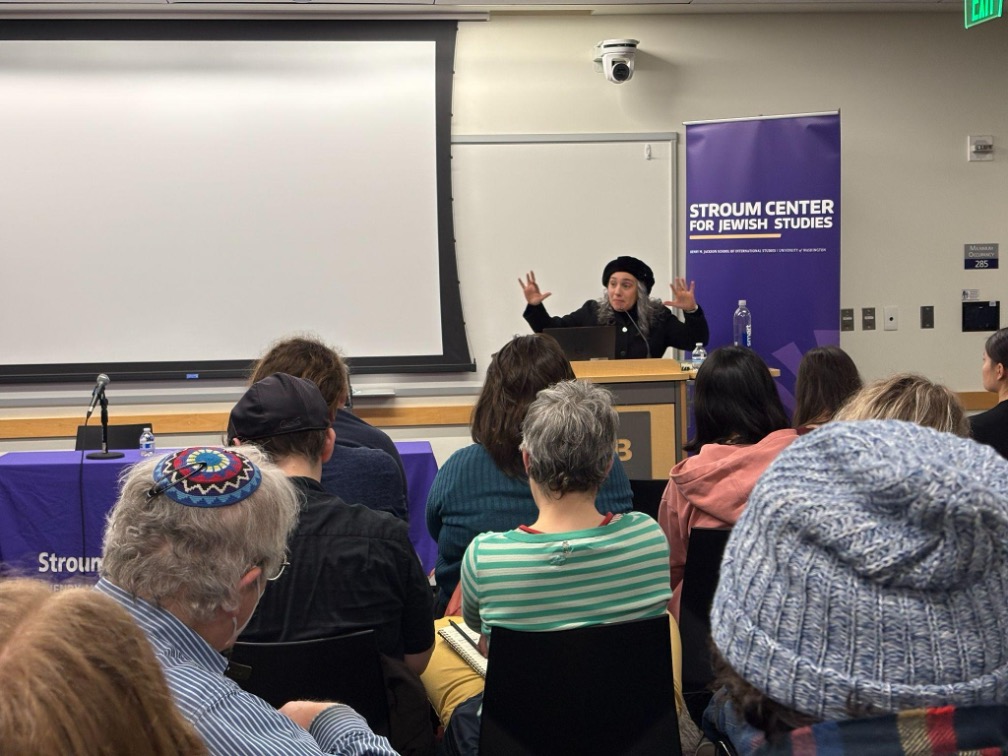
Miriam Udel speaks at the Jan. 28 lecture “Umbrella Sky – Modern Jewish Worldmaking Through Yiddish Children’s Literature.” Photo by Madison Morgan
By Madison Morgan
Around the turn of the 20th century, Yiddish-speaking educators, authors, and cultural leaders undertook an ambitious project: to create an entire literary world for children. Nearly 1,000 books and several periodicals emerged alongside the secular Yiddish school systems that flourished across Europe, the Americas, and beyond in the 1920s and 30s. These texts shared a common aim: to write into being a “shenere un besere velt,” a more beautiful and better world, in a distinctively Yiddish key.
Miriam Udel, director of the Tam Institute of Jewish Studies at Emory University, brought that history to life in her Jan. 28 talk, “Umbrella Sky – Modern Jewish Worldmaking Through Yiddish Children’s Literature” for the Stroum Center for Jewish Studies (SCJS). Drawing on her book “Modern Jewish Worldmaking Through Yiddish Children’s Literature,” a winner of the 2025 National Jewish Book Award, Udel approached these texts not merely as historical records, but as active sites where values are taught, futures imagined, and political ideas formed.
“Children’s literature is a novel archive for the study of Ashkenazi Jewish modernity, because the whole story of how Jews became modern … was addressed in this whole other way, where instead of trying to get over the culture, you’re kind of in the position of a little kid looking up at all these adult questions,” Udel said.
According to Udel, children’s literature also functioned as a way to escape harsh, real-life conditions; through stories like “Olke” and “The Girl in the Mailbox,” she examined how the female leads imagined worlds beyond their immediate circumstances.
Beyond the book
Earlier on Jan. 28, Udel led a translation workshop titled “Muddy ‘Boots’: How Translation Fuels Critical Scholarship” where participants worked directly with Yiddish texts. Udel, who is also the editor and translator of “Honey on the Page: A Treasury of Yiddish Children’s Literature,” explained how the process of literary translation allowed her to “get inside the text,” deepening her understanding of a wide range of works. As a case study, she guided participants through a Soviet Yiddish narrative poem by Leyb Kvitko, “Buts un di sanitarn,” rendered in her translation as “Boots and the Bath Squad.” The session highlighted translation as both a practical and interpretive act, shaped by audience, context, and choice, encouraging close attention to nuance and the small decisions that shape meaning.
The following day, she visited Associate Professor Sasha Senderovich’s “Jewish American Literature and Culture” course, where students engaged with the film “Labzik: Tales of a Clever Pup,” adapted from Udel’s translations of Yiddish author Chaver Paver’s work.
“I thought that the historical elements [of the talk] were really interesting,” Brian Rocca, a student in Senderovich’s class who also attended the Jan. 28 lecture, said. “I wasn’t super familiar with the history of how Yiddish has evolved at large. And then personally in my English major studies, I find children’s literature particularly fascinating, so hearing about how the genre evolved was pretty interesting for me.”
Miriam Udel answers a question from University of Washington undergraduate Brian Rocca during the lecture “Umbrella Sky – Modern Jewish Worldmaking Through Yiddish Children’s Literature” on Jan. 28. Photo by Madison Morgan
Bringing Yiddish to life
Udel’s visit also highlighted the Stroum Center’s nationally and globally recognized strength in Yiddish Studies. SCJS supports a deep concentration of Yiddish scholars — Senderovich, Barbara Henry, Annegret Oehme, and Rafael Balling — whose research spans literature, history, translation, and cultural studies. Rather than treating Yiddish as a narrow specialty, the Stroum Center approaches it as a lens for understanding modern Jewish life across time and place, connecting research with teaching and public engagement.
“In 2023 the musician Anthony Russell was speaker in the Stroum Lecture series; in 2025 the Stroum Center made it possible for me to invite Naomi Seidman and, in 2026, Miriam Udel; and next year’s Stroum Lectures will be given by Saul Noam Zarritt,” Senderovich said. “So, through these higher-profile public events, there’s attention on Yiddish.”
Connecting scholarship and community
Udel’s visit highlighted what the Stroum Center does best: bringing scholarship into conversation with the public. The event fostered dialogue between students, faculty, and community members, creating a space to explore Jewish culture and ideas in meaningful ways.
For Nicolaas Barr, it was a space to reconnect with lost family history. According to Barr, a lecturer with the Comparative History of Ideas Department and affiliate at the Stroum Center, his family spoke Yiddish until emigrating to the United States, at which point it was not passed down. Part of his motivation for attending Udel’s talk, Barr said, was to engage with the Yiddish language.
“Some people learn certain languages because of their cultural and historical significance, more than for the practical use of speaking … I’m interested in [Yiddish] because it’s part of my family history that’s been lost, and I’m trying to recover that,” Barr said. “And I think [Yiddish] has a distinct textural quality. That’s what’s so neat about languages — you can translate them, but you can also learn them and find your way into those textures.”
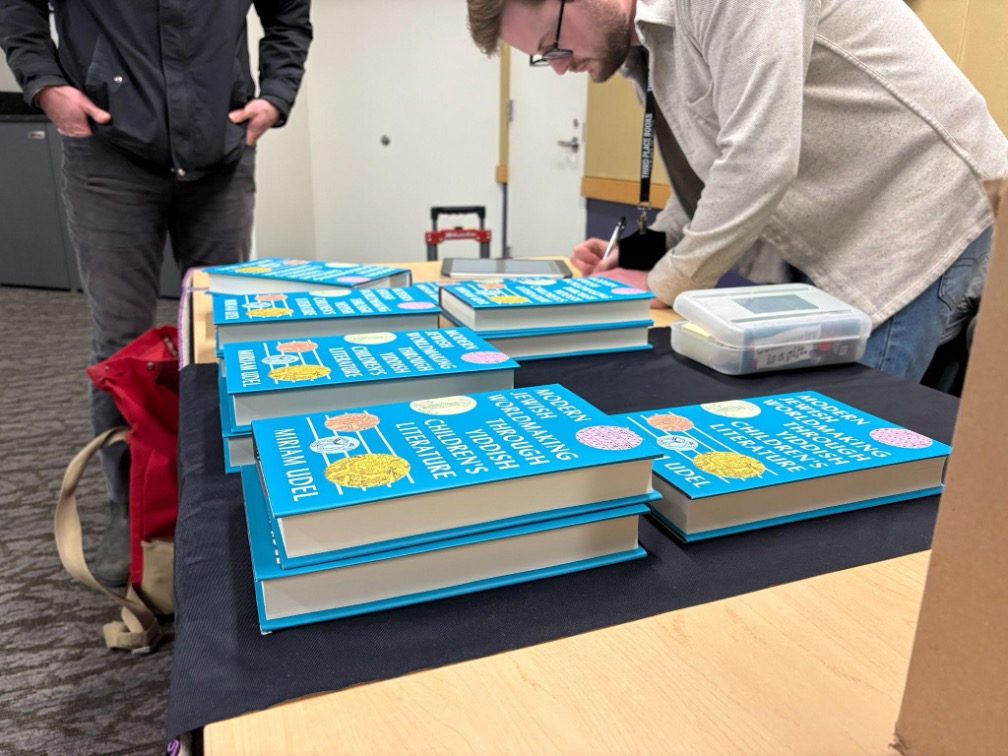
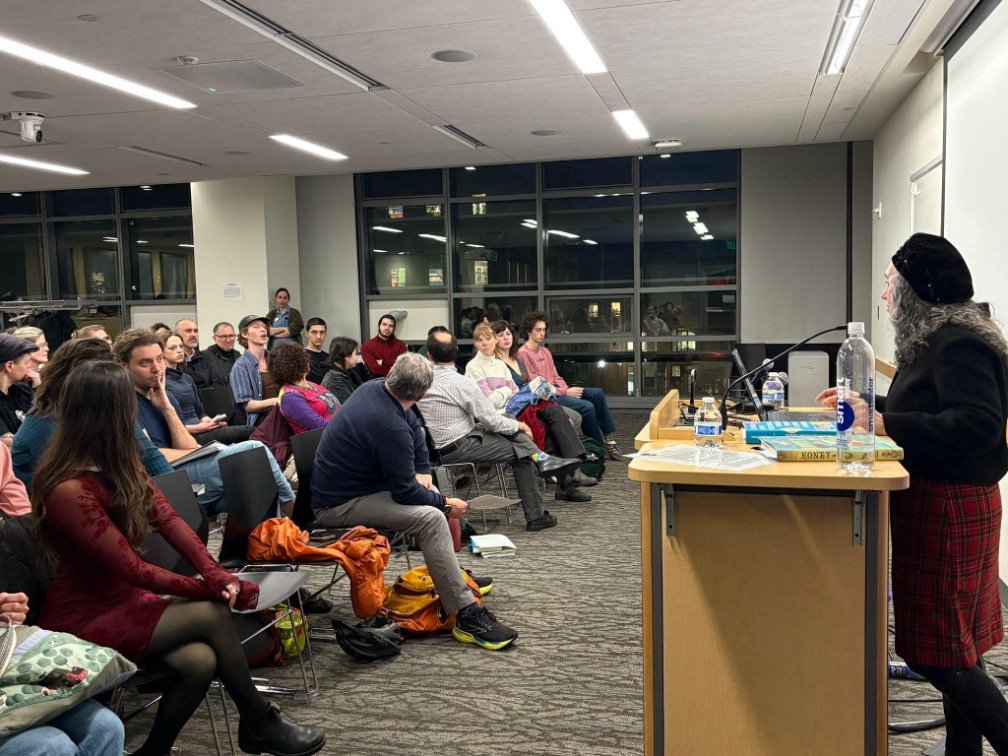
Third Place Books sells copies of Miriam Udel’s book “Modern Jewish Worldmaking Through Yiddish Children’s Literature” during the Jan. 28 lecture. Photo by Madison Morgan