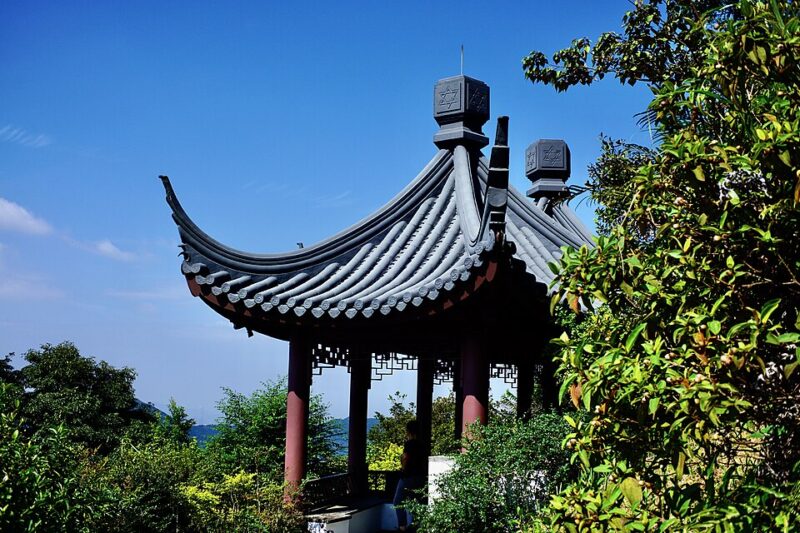
View of the Kadoorie Brothers Memorial Garden in the Kadoorie Brothers Farm and Botanic Garden in Hong Kong, Wikimedia Commons
Jewish life in Hong Kong is not very well known in mainstream Jewish spaces. One of the busiest ports and business centers in the world, Hong Kong is home to an extremely diverse population from all corners of the world. Nestled in the Central neighborhood of the city, there is a small but interestingly active, dynamic, and diverse Jewish community. While most of the current community is Sephardic and Ashkenazi, Hong Kong was once the business center of two important Jewish families originally from Baghdad: the Sassoon Family and the Kadoorie Family. These families built what Dr. Sasha Goldstein-Sabbah calls “satellite communities” in her book Baghdadi Jewish Networks in the Age of Nationalism and formed vast social, cultural, linguistical, and philanthropic networks that connected them to most of the globe while keeping close contact with Baghdad.
Elly Kadoorie (1867-1944) was born to a Baghdadi Jewish family involved with trade in the Middle East and India and is a great example of how these networks operated and came to be. In 1880, Kadoorie’s work in the Sassoons’ opioid business brought him to Hong Kong. Dividing his time between Shanghai and Hong Kong, he managed to open his own brokerage firm in the latter, where he settled semi-permanently. In Hong Kong, Kadoorie invested heavily in real estate and hospitality, and used the profits to donate to a wide range of institutions around the globe catering to women’s education, the poor, and the ill. His work also revolutionized industrial life in one of the most famous neighborhoods of the city, Kowloon. In 2007, Elly Kadoorie’s grandson, Sir Michael Kadoorie, founded The Hong Kong Heritage Project, in that very neighborhood to “preserve and promote heritage awareness” in Hong Kong.
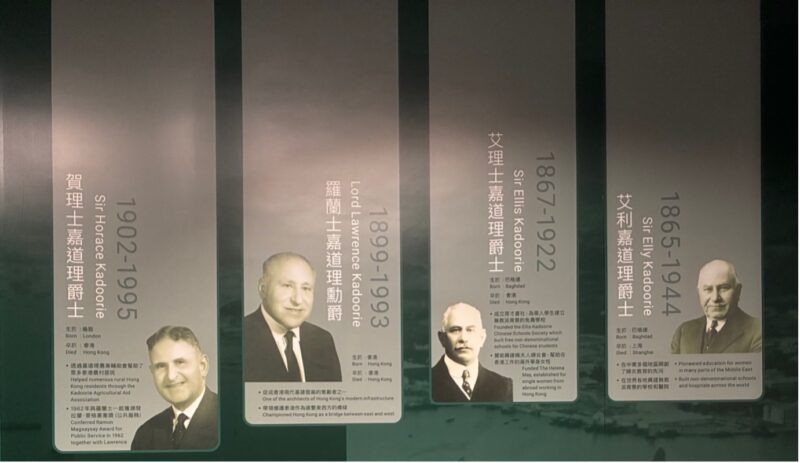
Entrance of Kadoorie Exhibition, The Hong Kong Heritage Project, Kowloon, taken by author in June 2025
The Society is also home to a public-access archive where it is possible to view and consult most of Elly Kadoorie’s correspondence throughout the early 20th century. Among the many letters, it is possible to recreate the extent of Kadoorie’s cultural and philanthropic network, and the many organizations and institutions he and his sons, Lawrence and Horace, supported throughout their life. Elly Kadoorie fashioned himself as a champion for Women’s rights, with an emphasis on education in a global sense, which can be gleaned by reading the numerous letters containing donations to various organizations around the world, including Hong Kong, mainland China, Iran, and in Turkey.
Elly Kadoorie gave to various institutions regardless of their religious, ethnic, cultural, and linguistic affiliation, and was a dedicated donor to Christian and Chinese institutions, such as the Hong Kong Young Women’s Christian Association, the Po Leung Kuk (a relief organization for women and children that provided elementary education), and the Ellis Kadoorie Chinese School Society, founded by his brother Ellis Kadoorie, which opened many schools all over mainland China and Hong Kong.
Elly’s wife, Laura Kadoorie (1865-1918) also played an essential role in the Kadoorie Family’s philanthropic work. Laura was born in London to the Mocatta Family, an aristocratic family known for their philanthropic involvement in the arts. The couple met in the British capital and soon married at the West London Synagogue in 1897. Many institutions financially supported by the Kadoories bear her name. One example is the first school opened by the French educational institution Alliance Israélite Universelle (AIU) in Baghdad, called the Lady Laura Kadoorie School and Atelier for Girls.
The Kadoories collaborated extensively with the AIU beyond the school in Baghdad through other projects throughout Iraq, Iran, and Turkey that extended beyond education. For example, between the late 1920s and 1940s, the Kadoories donated and supported a wide range of institutions through the AIU, such as Jewish hospitals and daycare centers. One example is the Balat Or Hayim Hastanesi, a Jewish hospital in Istanbul, Turkey. The hospital’s reputation grew in the early 20th century, appearing on Jewish press in the region, including the Ladino newspaper La Bos de Oriente, which described the hospital as a “pearl of Turkish Judaism” (una perla del judaismo turko) in an article in April 1932.
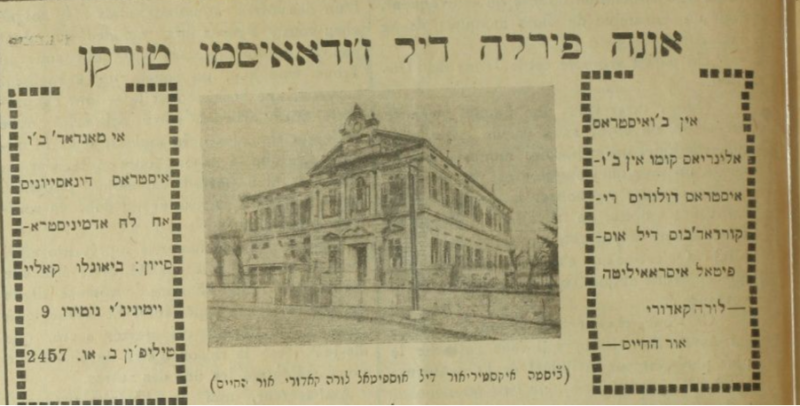
“Una Perla del Judaismo Turco”, La Bos de Oriente, April 20th, 1932, Sephardic Studies Digital Collection, University of Washington.
Elly Kadoorie and his sons substantially supported the ideological and financial purpose of the hospital, and it was renamed the Laura Kadoorie Or Hayim Hospital in 1920. Interestingly, their extensive correspondence with the AIU, hosted at the Hong Kong Heritage Project, covers matters beyond those pertaining to the hospital, such as the political situation in Germany. Kadoorie’s steadfast contributions to the financial well-being of the hospital was suddenly in peril due to the rise of Nazism in Germany and the spreading of antisemitic legislation across Europe.
The enactment of Germany’s Nuremberg Laws in 1935 severely impacted Jewish life across Europe and caused widespread migration that led thousands to find refuge in East Asia, home of the Kadoories trading empire. As the need grew, the Kadoories concentrated their philanthropic efforts into assisting the newly arrived Jewish refugees and integrating them into the existing Jewish communities of Shanghai and Hong Kong. As the Kadoories focused their financial resources on assisting refugees from Europe, their contributions to the AIU decreased in frequency, resulting in unexpectedly tense exchanges with the organization regarding their financial commitment to several institutions in South West Asia, including the Or Hayim Hospital.
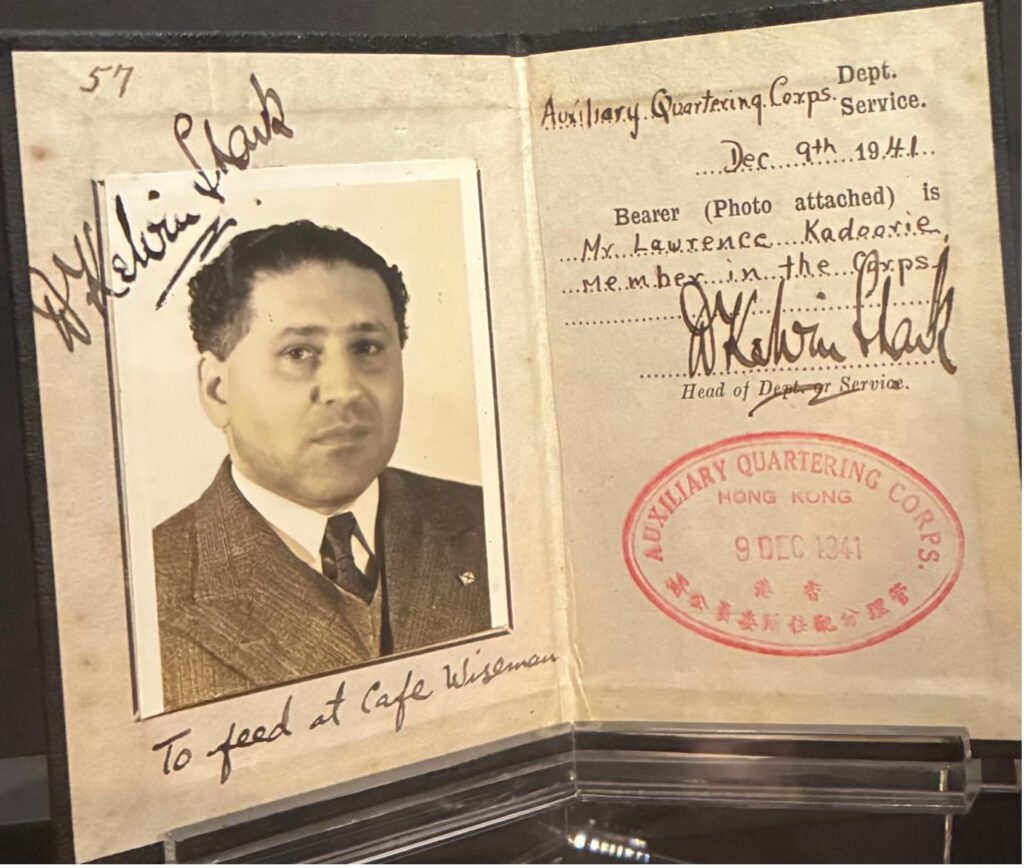
Lawrence Kadoorie’s personal pass during Japan’s occupation of Hong Kong, The Hong Kong Heritage Project, Kowloon, taken by author in June 2025.
Later generations of Kadoories proudly continued the family’s dedication to philanthropy, forever changing life in Hong Kong. The family was especially involved in rebuilding efforts in the aftermath of the Second World War and Japanese occupation of Hong Kong. Lawrence (1899- 1993) and Horace (1902-1995) Kadoorie founded the Kadoorie Agricultural Aid Association (KAAA) in 1951 to introduce different agricultural programs that helped poor farmers in Hong Kong. The KAAA is only one example of the extensive philanthropy work carried out by the Kadoories in Hong Kong, and their long-lasting effects in the region to this day. In 1995, the association eventually gave life to the Kadoorie Farm and Botanical Gardens protected area in the New Territories dedicated to biodiversity conservation, organic agriculture, and environmental awareness.
Kadoorie Exhibition, The Hong Kong Heritage Project, Kowloon, taken by author in June 2025
The Kadoories’ philanthropy is only one example that shows the significant roles Baghdadi Jews have played in different communities and societies throughout the globe, extending beyond the sphere of Jewish religious, cultural, and communal life, as shown by the family’s commitment to Chinese educational institutions. While Baghdadi Jews are often situated at the periphery of history, stories such as those of the Kadoorie Family open our eyes on the interconnectedness of Jewish communities expanding through regions, languages, and cultures.
The stories of Elly, Horace, and Lawrence Kadoorie enrich our knowledge and perception of Jewish life and the many ways it was experienced in different communities and regions throughout history and time. Jews in Hong Kong became embedded with the history and cultural life of the region, adding to the diverse tapestry of the place. To their eyes, Jewish life in Hong Kong was neither circumstantial, nor exceptional: it was home.
By Chava Fisicaro
Mickey and Leo Sreebny Memorial Fellow
 Chava is a Ph.D. student in Near and Middle Eastern Studies at the University of Washington. Originally from Milan, Italy, she completed her B.A. in Philosophy at Vrije Universiteit Amsterdam and her M.A. in Middle Eastern Studies at the University of Amsterdam. Her research interests include the Jewish communities of Italy, Libya, and Rhodes, and their relationship with colonialism, migration, and network building. Her M.A. thesis researched the participation of Italian Jewry in the Italian colonial effort in Libya and Rhodes through the study of Jewish press in Italian, Ladino, French, and Arabic from Turin, Rhodes, Tripoli, and Cairo. For her Ph.D. dissertation, she plans to investigate the role of Jews of Italian origin who settled in Ottoman Turkey and Greece in building transnational networks linking the Eastern Mediterranean and MENA (Middle East and North Africa) regions to Asian port cities and Western Europe. Outside of academia, Chava loves cooking Persian food, the Lord of the Rings, urban hiking, and dim sum.