Image courtesy of Meryl Schenker Photography
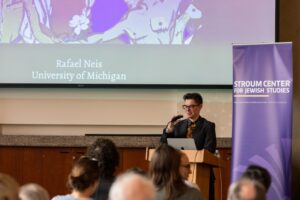
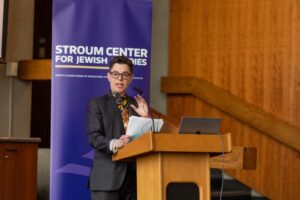
This past May, the Stroum Center for Jewish Studies was honored to host Professor Rafael Neis for our 2026 Samuel and Althea Stroum Lecture series. Neis – a scholar and artist whose work is reshaping conversations about rabbinic literature, gender, trans-ness, and visual culture – presented two public lectures, a colloquium for Jewish Studies faculty and graduate students, and a zine-making workshop with undergraduate students.
Neis’s scholarship examines the culture of the rabbinic movement in antiquity, placing rabbinic texts in conversation with the broader worlds of the late ancient Mediterranean. Trained in Jewish Studies, religious studies, law, and visual art, Neis brings an unusually expansive and interdisciplinary lens to the study of ancient Judaism, which was apparent to this year’s Stroum Lectures attendees.
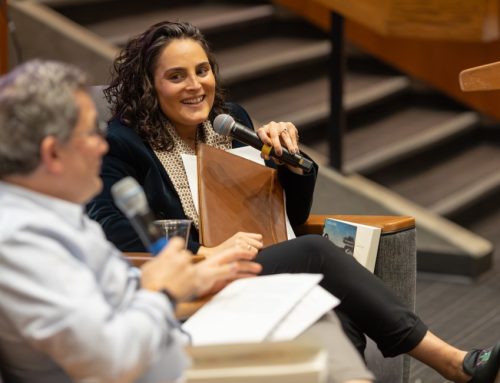
Neis has a special connection to the University of Washington, as the Stroum Center for Jewish Studies is a sponsor of their podcast aderaba, which is co-hosted by our Hazel D. Cole Fellow, Gilah Kletenik. Neis and Kletenik delight listeners as they explore big questions through a diverse range of Jewish texts, ideas, and cultures. Kletenik served as faculty host for this year’s Stroum Lecture series and said Neis’s background made them an especially exciting guest lecturer: “Professor Rafael Neis’s scholarship is at the cutting edge of work in the fields of rabbinic literature, classics, trans studies, and visual culture.”
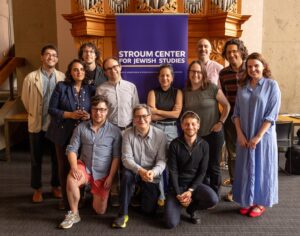
Stroum Center faculty at this year’s first Stroum Lecture. Image courtesy of Meryl Schenker Photography
Sasha Senderovich, Stroum Center faculty member who served on the Stroum Lecture committee, reflected after this year’s events:
“This was an extraordinarily rich week of learning from and with Rafael Neis… [who] made a compelling case for rethinking the very foundations of how we come by our knowledge and assumptions about gender in a dizzying array of disciplines, illustrated with compelling examples from Talmudic sources and art history / archeology of ancient Palestine and Mesopotamia. (And peppered, I must add, with some excellent jokes, a deployment of a number of voices and accents, and illustrated with Rafe’s own art.)”
Both public lectures are now available on the Stroum Jewish Studies YouTube channel in our Stroum Lectures playlist.
The first lecture, Have ‘Men’ and ‘Women’ Always Existed? What the Talmud Can Tell Us, reconsidered one of our most basic assumptions: that the categories of “man” and “woman” are timeless and self-evident. Turning to rabbinic texts, Neis argued that the sages wrestled with bodies, identity, and social roles in ways that do not map neatly onto modern frameworks. By bracketing what we think we already know about gender, lecture-goers discovered a rabbinic tradition that is more curious, complex, and inventive than we might have expected.
The second lecture, Monsters, Hybrids, and Holy Images – Rethinking Bodies in Ancient Jewish Art, shifted from text to image. Through close attention to striking examples of ancient Jewish art, Neis probed what becomes visible when we resist sorting figures into familiar categories such as human or animal, male or female.
This year we were especially grateful for an additional two events focused on our Jewish Studies students, a colloquium entitled “Before Gender: Trans Methods for Jewish Studies and Ancient History,” and a zine-making workshop that provided a more informal opportunity for students to engage with Dr. Neis not just as a scholar but as a talented artist.
Together, the week of events opened space for rethinking identity, embodiment, trans-ness, and the sacred in late antiquity. We hope Professor Neis’s lectures will lead to a book with UW Press, continuing our Stroum Lectures tradition that includes publications by notable Jewish Studies scholars Yosef Hayim Yerushalmi, Paula Hyman, Anita Norich, and others.
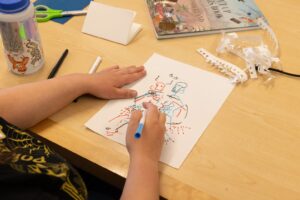
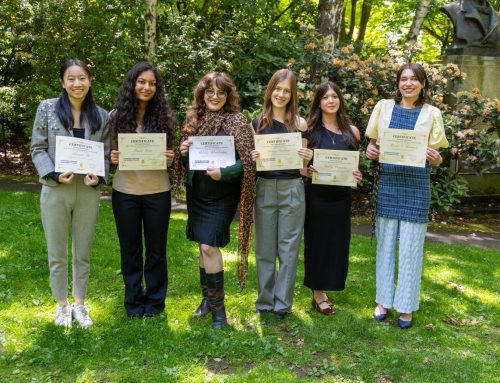
Art making at Professor Neis’s student-focused zine-making workshop. Images courtesy of Meryl Schenker Photography
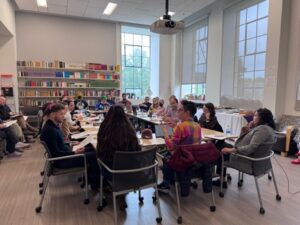
Students and faculty engaging with Professor Neis during their lunchtime colloquium
About the 2026 Stroum Lecturer
Rafe Neis was mostly recently a Professor in the Department of History and Frankel Center for Judaic Studies at the University of Michigan – and has just joined the University of California at Berkeley as Professor in the Department of Middle Eastern Languages and Culture. Their research focuses on the culture of the rabbinic movement of the first centuries C.E. in Roman Palestine and Sasanian Mesopotamia. They seek to instigate inquiries about more than human worlds, ritual, gender, and classification. They are committed to multi-media forms of knowledge-making and sharing, from websites to workshops and from comics to collaborative zines. Their first book The Sense of Sight in Rabbinic Culture: Jewish Ways of Seeing in Late Antiquity (Cambridge University Press, 2013) won the Salon Baron Prize for best first book in Jewish Studies and an honorable mention for the Jordan Schnitzer Award for books published in Biblical Studies, Rabbinics, Jewish History and Culture in Antiquity in 2010-2013. Their second book, When a Human Gives Birth to a Raven: Rabbis and the Reproduction of Species (University of California Press, 2023) investigates “generation” (aka reproduction) and the creation of species in ancient Jewish writings and other sources in the Mediterranean, Southwest Asia, and North Africa. Professor Neis studied painting at the Bezalel Academy of Arts & Design, at Camden Working Men’s College, received their MA in Religious Studies from Boston University, and their PhD in Jewish Studies from Harvard University.
The Stroum Lectures in Jewish Studies is a nationally-renowned series of public lectures, which has brought Jewish studies luminaries from around the globe to the University of Washington for more than fifty years. Made possible through the support of the Samuel and Althea Stroum Lectures Endowment, this annual series is a cornerstone program of UW’s Stroum Center for Jewish Studies and has led to impactful conversations, groundbreaking scholarship, and award-winning publications. You may view the full Stroum Lectures archive here and review corresponding books published by University of Washington Press here.