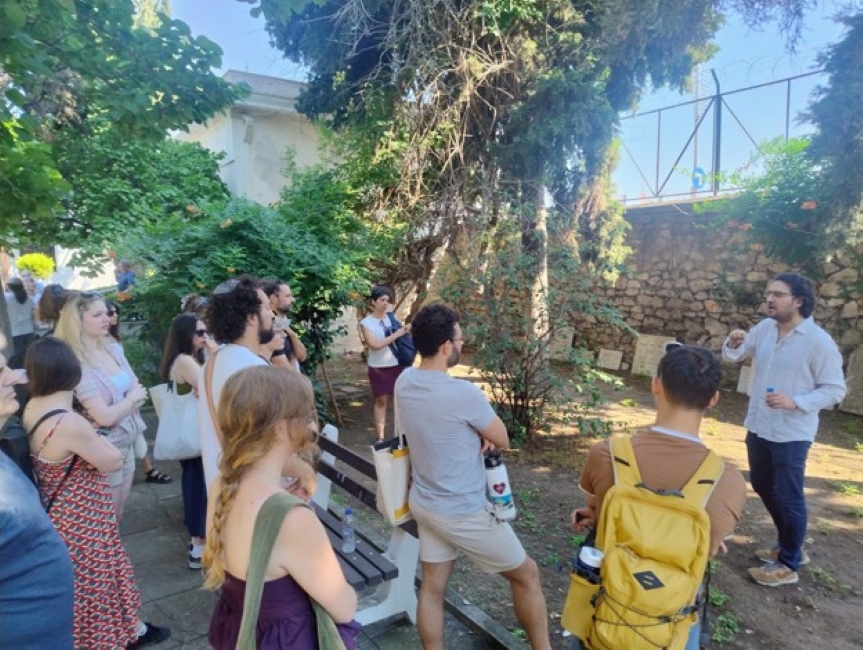
Devin Naar speaks about the fate of the pre-war Jewish cemetery of Salonica while students gather in the post-war Jewish cemetery. Salvaged fragments of pre-war tombstones may be seen lined up against the wall in the background. (Photo by Paris Papamichos Chronakis)
In June 2026, three UW PhD students joined thirteen other PhD students from around the world—mostly Europe and North America—to attend the first-ever International Summer Institute on Modern Balkan and Eastern Mediterranean Jewries in Thessaloniki, Greece. The five-day institute — co-hosted by UW Sephardic Studies Program Chair and Isaac Alhadeff Professor of Sephardic Studies Devin Naar, and led by Royal Holloway University of London Professor Paris Papamichos Chronakis, with participation from Jewish Studies Chair of Aristotle University Giorgos Antoniou — was an extraordinary opportunity for students and scholars from around the world to deepen their understanding of the fast-growing field of Sephardic and Mediterranean Jewish Studies and to delve into Jewish Salonica, once touted as the “Jerusalem of the Balkans,” which was destroyed in WWII and whose population was almost entirely deported to and murdered at Auschwitz-Birkenau in 1943.
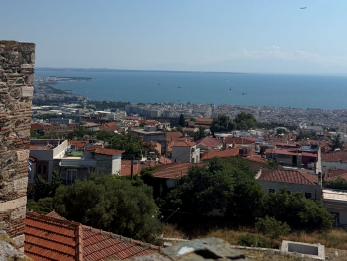
View of Thessaloniki harbor from the guard tower of Heptapyrgion Acropolis of Thessaloniki. Photo by Sasha Ward
The packed program involved the following learning opportunities: Naar offered a workshop at the Jewish Museum of Thessaloniki about the pre-World War II communal archives materials handwritten in Judeo-Spanish, using the now-defunct soletreo script that had been confiscated by the Nazi occupation forces during the war and miraculously survived; Naar had first catalogued these archives and curated an exhibition about them at the Jewish Museum of Thessaloniki as a Fulbright scholar twenty years ago. In another workshop, held on location at the post-war Jewish cemetery, about remnants of the tombstones from the pre-war cemetery that had been destroyed by local Greek authorities during the Nazi occupation of the city. Papamichos Chronakis, who visited UW earlier in 2026 to present his new book about Jewish and Greek merchants in early twentieth-century Salonica, offered a seminar on class as a category of analysis in the history and historiography of Sephardic Jewish history, with a focus on the bourgeoisie. Antoniou guided the group on a walking tour of the city center to discover the many layers and erasures of the Thessaloniki’s history, with a focus on identifying echoes of the Jewish and Ottoman pasts.
In addition to the main organizers, other scholars enhanced the experience for the students. Matthias Lehmann, University of Cologne, offered a seminar on religion and religiosity in modern Sephardic history and another on the Mediterranean in Jewish historiography; Constantine Iordachi, Central European University (Vienna and Budapest), focused his first lecture on the intersections of fascism and antisemitism in the region and a second on the links between fascism and the Holocaust in southeastern Europe. Nadége Ragaru, from Science Po, Paris, lectured on women survivor testimonies regarding a 1944-1945 trial about antisemitism in Bulgaria.
The participants’ learning experience was further enriched by additional hands-on and interactive opportunities. Aliki Arouh, archivist of the Jewish Community of Thessaloniki, showed the group files from the Nazi occupation, including the original property registrations of the city’s Jews from 1943, just prior to their deportations to Auschwitz. Esther Solomon (Athens School of Fine Arts) presented and discussed her 2024 documentary film, “Lost Yannina: A Topography of Jewish Memory. During a visit to the Archeological Museum of Thessaloniki, curator Styliana Galiniki spoke to the group about archeology and the Jewish past, and local Jewish community member and activist Peppo Vaena spoke about his role reclaiming artifacts from the Jewish past—especially tombstone fragments scattered across the city.
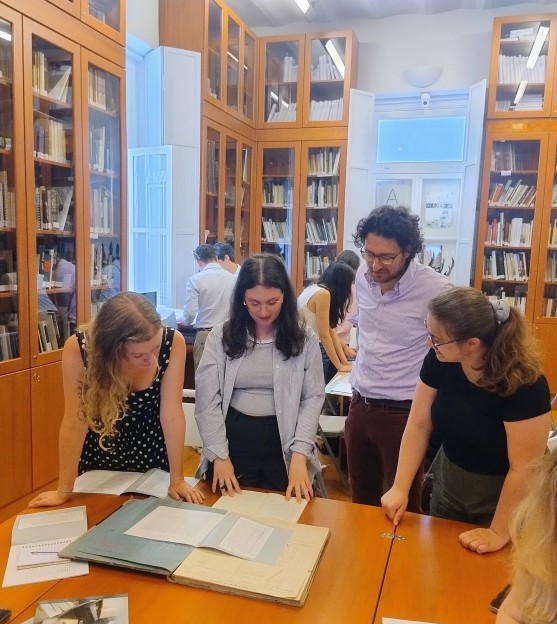
Naar works with graduate students (L to R) Juliette Rosenthal (Berkeley), Chava Fisicario (UW), and Alexandra Ritstatos (UW) to decipher a 1934 Ladino register of impoverished Jews living in Vardar, at the outskirts of Salonica. (Photo by Paris Papamichos Chronakis)
The visit to the Jewish cemetery, pictured at top, was particularly poignant both for Professor Naar and for Stanford graduate student and former UW Sephardic Studies assistant director, Makena Mezistrano, whose Abravanel and Saltiel forebears, like Naar’s, had been buried there for centuries.
Finally, Andromache Gazi, Panteion University of Athens, who serves as the curator of the new Holocaust Museum of Greece currently under construction in Thessaloniki, offered participants a sneak preview of the main exhibition concept and delved into the challenges posed by the intersection of politics and memory.
In addition to dining together, the graduate students also had the opportunity to workshop chapters from their dissertations and conference papers, and to receive feedback from their peers and from the faculty. Professor Papamichos Chronakis served as the primary lead in Thessaloniki and coordinated the many engaging aspects of the program.
The Summer Institute formed part of the multi-year grant project “Global Jewish Studies in/as Holocaust Studies”, funded by Rothschild Foundation (Hanadiv) Europe (2023-2026) and led by the Holocaust Research Institute at Royal Holloway University of London. The Summer Institute constituted a core component of a broader initiative that seeks to build networks with scholars of Eastern and Southeastern European Jewish Studies in the region and beyond, and to ensure the sustainability of Jewish Studies in both the UK and Southeastern Europe.
Read on for the three UW students’ reflections on their time at the institute.
Exploring Sephardic Jewish Histories in Thessaloniki
by Alexandra Ritsatos, History PhD Student
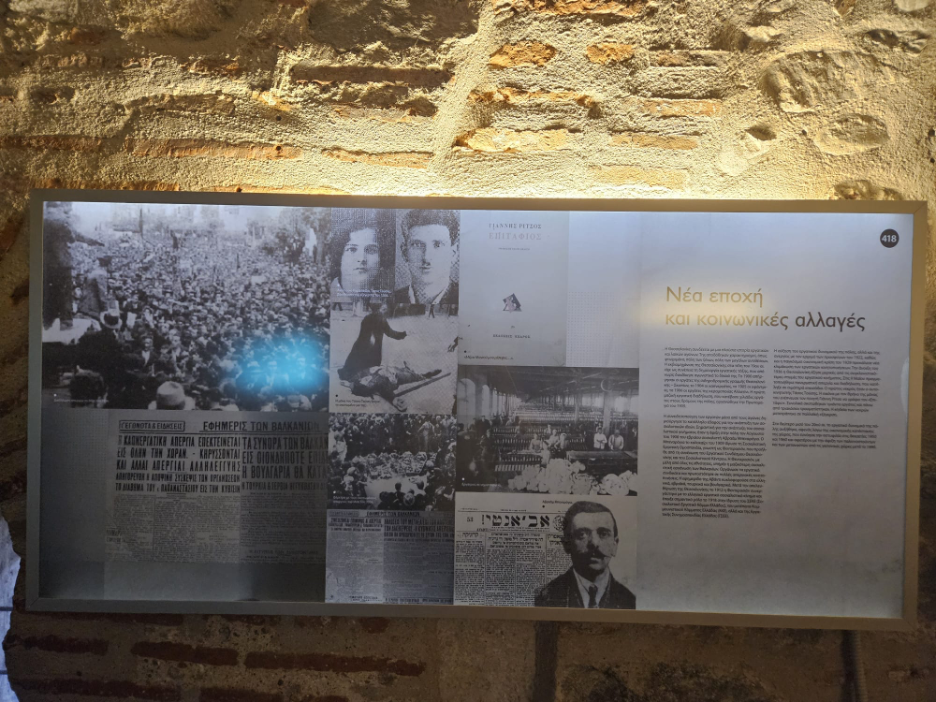
A panel at the museum of the White Tower featuring Salonican Jewish socialist Avraam Benaroya at the center of the political transformations of the early twentieth century
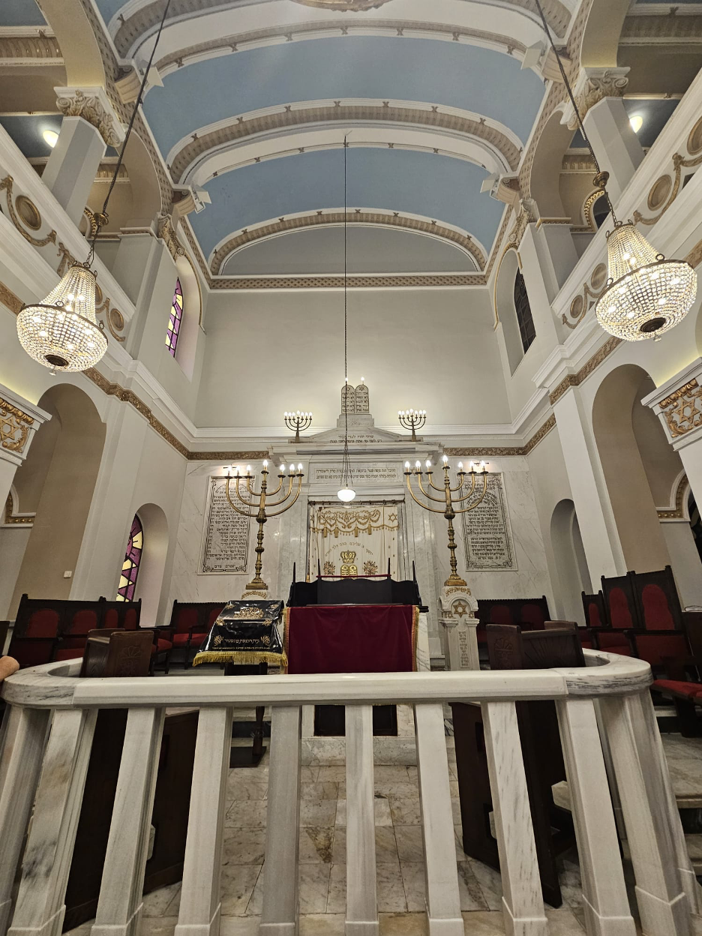
Monastir Synagogue in Thessaloniki, the only pre-war surviving synagogue in the city. The synagogue survived because it was a Red Cross warehouse
This past June I attended the International Summer Institute on Modern Balkan and Mediterranean Jewries in Thessaloniki. This was one of the most fun and fulfilling experiences of my graduate academic life since I started my PhD program in the fall of 2023. It was a unique experience to be amongst some of the leading scholars of Sephardic histories and also get to know the exciting works of other graduate students like myself. I found the relationships that I was able to build with my peers during this program to be among the most rewarding of experiences!
During the Institute we participated in many different activities, from lectures and academic workshops to visiting the Jewish Museum and the Archive of the Community among others. I found the visit to the community archive deeply informative and loved listening to the archivist’s stories about her work experiences especially surrounding genealogy. Visiting the Community’s Cemetery was also a deeply moving experience where the old cemetery’s remnants brought to life the city’s violent and complicated history. Since the cemetery is only open to a limited part of the public, visiting it was an opportunity that I could only have through attending the Institute.
I was also able to explore and sightsee around Thessaloniki. Along with some of the other participants in the program, we went to the Lefkos Pirgos (White Tower) to look for the looted tombstones from the old Jewish cemetery which were used as building materials around the city in the postwar period. On Saturday, after checking out from my hotel I was able to visit the museum inside the Lefkos Pirgos where I was pleasantly surprised to find some of the historical figures I study present. Overall, attending the Institute and visiting Thessaloniki was such a fulfilling experience!
Beyond Homer: Connecting to My Sephardic Heritage in Greece
by Chava Fisicaro, Near and Middle Eastern Studies PhD Student
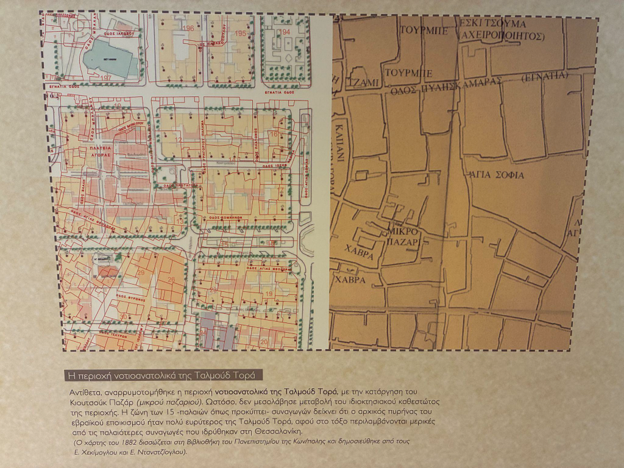
Map of Jewish districts in the Old City of Thessaloniki
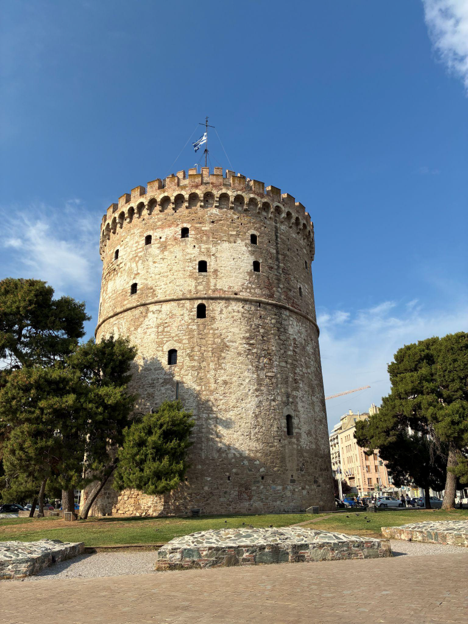
The White Tower of Thessaloniki
I arrived in Thessaloniki in June 2026, together with other PhD students and graduates, for the International Summer Institute on Modern Balkan and Eastern Mediterranean Jewries. The first year of my PhD had shaped the city into a hybrid of what I had always associated Greece with (meaning, Homer and Theseus, an intricate labyrinth of myths, faulty gods, and heroines) with the image of a bustling and lively port city where Jews, Greeks, Turks, and many others lived side by side in orchestrated complexity. The International Summer Institute gave me the opportunity to walk through the same streets I had read about, to touch, feel, and unravel, layer after layer, the intricate tapestry of histories, languages, and cultures that left their imprint onto the city. Reading and listening to Ladino (my ancestral language, one I associate with bickering, singing, and cooking) in the heart of Thessaloniki, and seeing how it brought together all of us participants to the Institute regardless of our backgrounds, deeply moved and motivated me to continue the work in preserving the history of the city and its peoples.
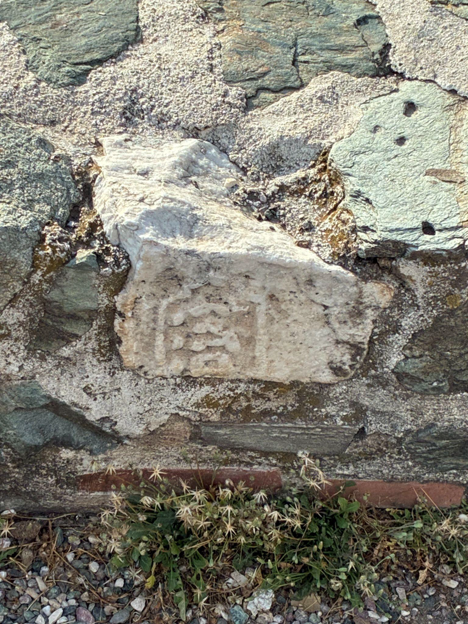
Remains of a Jewish grave used as a cobblestone in the remodeled square outside the White Tower
The seminar-part of the Institute’s program only enriched and added onto the experience. At Ypsilon, a modern building with attentive and friendly staff, we sat for hours at a rounded table, drinking freddo cappuccinos and involved in inspiring discussions on established works on Thessaloniki and Eastern Mediterranean Jewry. There, we also had the opportunity to present our own work to a group of incredibly knowledgeable colleagues and scholars, giving us the chance to form professional and intimate friendships that will accompany and carry a piece of Thessaloniki with us throughout our careers.
Memorial at the new Jewish cemetery of Thessaloniki
by Sasha Ward, Near and Middle Eastern Studies PhD Student
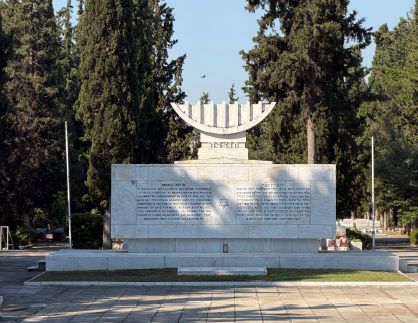
Memorial at the new Jewish cemetery of Thessaloniki
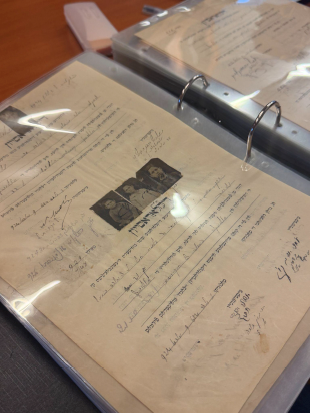
Examining newly-acquired documents and practicing our solitreo reading skills in the Archives of the Jewish Museum of Thessaloniki
One of the most rewarding aspects of the trip to Thessaloniki was the opportunity to situate the scholarly knowledge I’ve acquired over my years as a graduate student in the physical geography of the city. It is one thing to read about the rich cultural history of Jewish Salonica in textbooks, and another to walk the city streets and imagine daily life in a majority-Jewish city. While the Jewish Salonica that once existed on these shores no longer does, we nevertheless were fortunate enough to explore the remnants of its multicultural, multivectored past, and learn from scholars and community leaders who have dedicated their lives to cataloging lost archives.
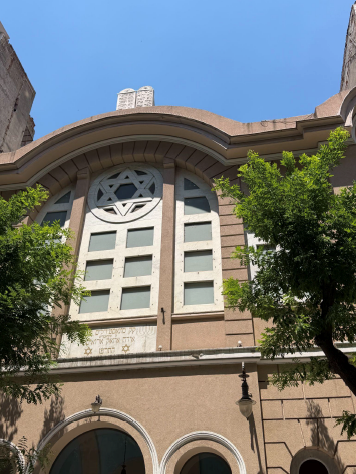
Exterior of Monastiriote synagogue
While the Summer Institute focused on the history of Salonican Jewry, the programming also looked to the future of Salonican Jewish historiography, too. We were able to meet with senior curators at both the Jewish Museum of Thessaloniki and the soon-to-open Holocaust Museum of Thessaloniki (which will absorb the former’s exhibitions) and discuss how scholars are thinking about how to narrativize Jewish life in Salonica and the Holocaust in Greece from Greek, Jewish, and global perspectives. We debated over the ethics of including graphic photographs and sensitive collections materials from the extermination camps, and whether or not these items serve to further dehumanize the victims of the Holocaust, or demonstrate the true extent of the atrocities of the war.
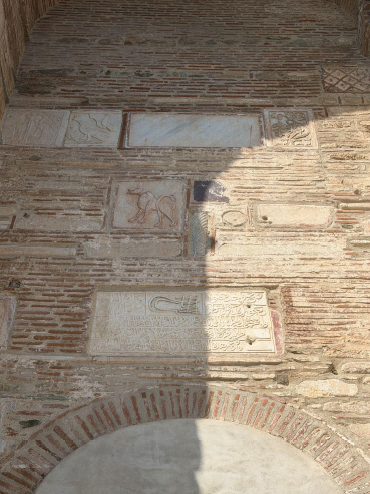
Placard found at the entrance of the Heptapyrgion Acropolis of Thessaloniki that details the Ottoman conquest of the acropolis
I found our visit to the Jewish cemetery to be particularly rewarding for my own work, as this provided the opportunity for me to compare Jewish tombstones from interwar Salonica with Turkish dönme (crypto-Jews from Salonica) tombstones from the same period.
Above all, though, I felt very fortune to be connected with other young scholars in my own field of Sephardi Jewish history and adjacent fields, like Holocaust and comparative genocide studies, whose works will indubitably shape how Jewish life in Salonica is understood by the broader public in the years to come.
I am grateful to the Stroum Center for Jewish Studies, which made my participation at the Institute possible.