Alexandra Ritsatos writes on the activism of Regina Roza, a Sephardic tobacco worker in 1930s Salonika, whose leadership in labor strikes reveals the erased history of Sephardic women in Greece’s interwar leftist movements.
Rizospastis newspaper cutout from May 19th, 1936. In the middle, there is a picture of working girls in Thessaloniki in the garment factories. This cutout reflects the increasing reality of working class girls’ employment in factories for very little daily wages.
By Alexandra Ritsatos
On April 29 1936 in Salonika, Greece, just a few days before May Day, also known as International Workers’ Day, tobacco workers were on the streets of the city demanding better wages and working conditions. Just a day later, on April 30 the strike spread to cities throughout the country. By May 3, more than half of the workforce of Salonika were on strike.
By May 8, a general strike was declared in Salonika but it was met with violence from the police leading to more than thirty arrests. These demands were the outcome of impoverishment and the austerity faced by the workers in the city. A day later, on May 9, the police attacked the striking workers. Twelve workers were killed and hundreds were injured. Among the workers that lost their lives in this strike were two Salonikan Jews Into Senor and Salvator Mataraso.
Rizospastis newspaper cutout, sometime in the summer of 1936. Photographed in the middle is the family of Ido Senor, who was killed on May 9th 1936. The family received financial support administered by the Tobacco Workers’ Commission of Kavala. The picture demonstrates the public interest which Rizospastis showed for the surviving family members of demonstrators.
Their stories are just one of numerous examples that highlight the involvement of working-class Sephardic Jews in the frontlines of the tobacco workers’ movement in 1920s and 1930s Salonika. The involvement of Sephardic Jews in the labor movement in the city of Salonika dates back to the very late-Ottoman period (1908-1912) and the Federasion Sosialista Lavoradera (Socialist Workers’ Federation). While the Federasion aimed to attract the support of workers from all ethno-religious communities, it remained a predominantly Jewish organization.
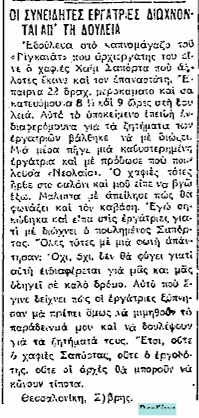
This is the sole newspaper article that I have found published by Regina Roza. The article was written in September of 1932 and published in the Greek-language newspaper Rizospastis. Roza reports about getting into trouble as an organizer at the factory she worked at. She recounts how she clashed with her employers and was later arrested.
While a lot remains to be recovered about Jewish labor organizing in Salonika, the participation of Sephardic Jewish women in this movement remains particularly unknown. In fact, Regina Roza, a Sephardic Jewish Salonikan woman, was on the organizing committee of the strike. In this essay, I hope to piece together some of the details about her life that I have been able to collect within the context of Salonika in the mid-1930s.
The strike on April 29th 1931 was declared by the Panhellenic Tobacco Organization. Regina Roza, a Sephardic Jewish Salonikan woman, was on the organizing committee of the strike. Roza was both the only woman and Jewish individual on the committee. Just a month after the culmination of violence on the streets of Salonika, Regina Roza was sent to internal exile to a Greek island.
Regina Roza is just one of the many Sephardic women who participated in the workers movement in Ottoman and Greek Salonika. In this essay, I piece together some of the details about her life that I have been able to collect within the context of Salonika in the mid-1930s. Her story is just an example of the erasure of Sephardic Jewish women from the memory of Salonikan radicalism in the interwar period.
Roza was a tobacco worker with the tobacco industry being at the center of the labor movement. By the mid-1930s when Roza became a prominent labor activist, Salonikan Jewish women and girls had worked in the tobacco factories for decades. Tobacco work was a primary source of income for Jewish teenage girls’ dowries, which were overrepresented within Salonika’s tobacco factories. The arrival of Eastern Orthodox refugee women from present-day Turkey increased the number of women working in the factories across the country and in Salonika specifically. These women were sometimes employed as the primary breadwinners of their household, while organized male tobacco workers fought to maintain a gendered hierarchy of pay.
In some cases, Jewish and Christian women and girls were active together in the labor movement. On December 9th 1932, Rizospastis published an article that reported the arrests of “Regina [Roza] and Despina”. These two women were arrested following a confrontation between women tobacco workers and the police due to the increased taxation of their daily wages. This article highlights the interconnected struggles of the Christian and Jewish Salonikan working class. It also brings forth the reality of surveillance and everyday violence experienced by labor activists in 1930s Salonika.
Many of the traces of Roza’s life that were left behind in Rizospastis recount instances in which she was arrested and faced police violence. Roza appears as a figure who cared a lot about her coworkers and especially the young women and girls working in the tobacco factories. As a result, when she was arrested by the police in early 1933, at least fifty tobacco women workers and twenty five men workers showed up to show their support for their colleague.
As a history graduate student at the University of Washington, I study the involvement of Sephardic Jews in the Greek left of the interwar period, the period between World War I and World War II. I am particularly interested in the activities of Sephardic women in the workers’ movement. While Regina Roza’s level of involvement and militancy was likely unique, her story represents the possibilities of political militancy. It also highlights the need to expand our knowledge of Sephardic Jewish Salonika in the 1920s and 1930s. How did these women define their activism? What were their visions for a better future?
To this day, I have been unable to find her picture or some of her basic biographical information. While her involvement in this historic strike was of great historical significance, Roza’s story remains neglected. I have not been able to determine the year she was born or how she died. She is one of the numerous women who were active in the Salonikan left before World War II but their stories are not commemorated in historical spaces. Roza was a union organizer, a tobacco worker and a popular colleague. She stood up for herself and others, and showcased a deep care for the wellbeing of other working Jewish teenage girls.
Roza’s story and militancy can provide a new lens in which to better understand Sephardic Salonika in the Greek nation-state. For some working class Jews living in the Greek state, the labor movement provided a space in which they could demand a better and more equitable future. However, the erasure of historical figures like Roza from popular and academic historical memory in Greece represents the limits of belonging in the interwar Greek left.
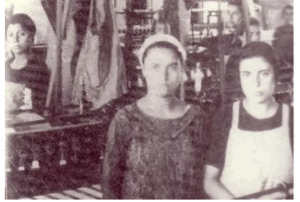
Image of working women in Salonika published in Rizospastis on March 15th, 1927.
 Alexandra Ritsatos is a third-year Ph.D. student in history at the University of Washington. Her research delves into the dynamics of working-class Jewish Salonika with a particular interest in the relational dynamics that were present in the labor and leftist movements of the city. Alexandra is particularly interested in examining the political activism of working-class Salonikan Jewish men and women as well as their non-Jewish neighbors and the political visions they put forth within the context of their changing city following its annexation by the Greek nation-state from the Ottoman empire. For her Ph.D. dissertation, Alexandra hopes to explore political activism and belonging among marginalized groups in Salonika and examine the dynamics between Sephardic Jews, refugees from Asia Minor and Armenians, in the interwar Greek communist left.