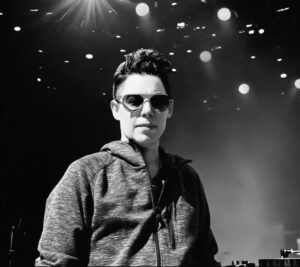
Rafael Neis
By Madison Morgan
For more than 50 years, the Stroum Center for Jewish Studies has welcomed leading voices in the field through its annual Stroum Lectures in Jewish Studies. This year’s two-part series, held May 12 and 14, features University of Michigan Professor Rafael Neis, a scholar and artist whose work is reshaping conversations about rabbinic literature, gender, and visual culture.
Neis’s research examines the culture of the rabbinic movement in antiquity, placing rabbinic texts in conversation with the broader worlds of the late ancient Mediterranean. Trained in Jewish Studies, religious studies, law, and visual art, they bring an unusually expansive and interdisciplinary lens to the study of ancient Judaism.
For Stroum Center associate faculty Gilah Kletenik, who helped coordinate this year’s lecture, Neis’s background made them an especially compelling choice.
“Professor Rafael Neis’s scholarship is at the cutting edge of work in the fields of rabbinic literature, classics, trans studies, and visual culture,” Kletenik said. “Their approach is rigorous, creative, and profoundly critical. Such excellence combined with their uncommon interdisciplinarity is why I thought that we’d be lucky to have Neis deliver the Stroum lectures. Neis is not just an exceptional scholar but an engaging presenter, adept at conveying layered, complex ideas in ways that are accessible and even entertaining to broad audiences.”
In their first lecture, “Did ‘Men’ and ‘Women’ Always Exist? What the Talmud Can Tell Us,” Neis will ask the audience to reconsider one of our most basic assumptions: that the categories of “man” and “woman” are timeless and self-evident. Turning to rabbinic texts, Neis argues that the sages wrestled with bodies, identity, and social roles in ways that do not map neatly onto modern frameworks. By bracketing what we think we already know about gender, participants will discover a rabbinic tradition that is more curious, complex, and inventive than we might expect.
The second lecture, “Monsters, Hybrids, and Holy Images – Rethinking Bodies in Ancient Jewish Art,” shifts from text to image. Through close attention to striking examples of ancient Jewish art, Neis will probe what becomes visible when we resist sorting figures into familiar categories such as human or animal, male or female. Together, the lectures will open space for rethinking identity, embodiment, and the sacred in late antiquity.
Kletenik hopes that by attending these lectures, participants will come away not only informed but transformed.
“Neis’s philological, theoretical, and historical work have an uncanny way of compelling us to rethink what we thought we knew about late antique Jewish culture as well as gender, visuality, and being human,” she said. “Neis’s teaching and research invite us to think otherwise, [and] I trust that participants will relish this opportunity.”
By engaging audiences in close readings, critical reflection, and unexpected connections, the talks reflect the kind of thoughtful, interdisciplinary dialogue the Stroum Center seeks to foster. Attending is an invitation to explore the complexities of Jewish culture, past and present, and to carry that curiosity into broader conversations in the academy and beyond.
“The Stroum Lectures began as a bold partnership between campus and community, bringing cutting-edge Jewish Studies scholarship to broad public audiences,” Noam Pianko, Director of the Stroum Center, said. “The annual lectures — and the more than 20 volumes published in the UW Press Stroum Lectures series — helped establish the then-emerging UW Jewish Studies program as a nationally recognized center for rigorous scholarship and vibrant public engagement.”
The Stroum Lectures in Jewish Studies is a nationally-renowned series of public lectures and a cornerstone program of the University of Washington’s Stroum Center for Jewish Studies. Made possible through the support of the Samuel and Althea Stroum Lectures Endowment, this annual series has led to impactful conversations, groundbreaking scholarship, and award-winning publications. See the past 50 years of lectures here.