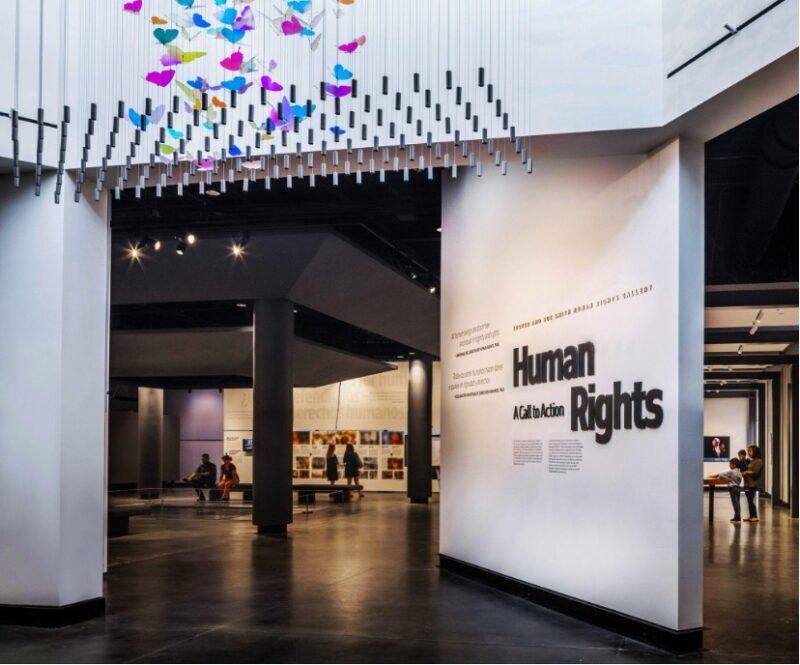
Holocaust Museum Houston’s Human Rights: A Call to Action Entrance
Lester and Sue Smith Human Rights Gallery
A visitor pauses in front of an exhibit on genocide, searching for meaning, for connections to the present, to other places, to the conflicts that fill today’s headlines. The museum does not make those connections for them. Instead, it offers something else: a set of patterns, a vocabulary, a way of seeing.
Holocaust museums in the United States exhibit a characteristic interpretive restraint. They limit explicit connections to other atrocities or direct commentary on current events in order to preserve historical specificity, maintain institutional credibility, and avoid politicization.
While Holocaust museums are often guided by a mission to prevent future atrocities, they rarely draw direct comparisons to other genocides, and much less explicitly address contemporary ones. Rather than making arguments about the present, they cultivate distance. In doing so, they rely on a set of informal yet consistent interpretive practices-“quiet rules” that prioritize specificity, abstraction, institutional authority, and strategic restraint. These rules allow museums to teach broadly applicable patterns without collapsing distinct histories into one another.
That said, in recent years, this balance has become harder to maintain. In particular, the Israel–Hamas war and the Palestinian cataclysm that followed the October 7 attacks have intensified the pressure on institutions to engage more directly with the present, raising urgent questions about how or whether Holocaust museums should extend (or generalize) their interpretive frameworks. From across the political spectrum, Holocaust museums face distinct criticisms. In 2025, the Holocaust Museum LA removed a general “never again” message after it was interpreted as a political statement, underscoring how even abstract language can trigger backlash. At the same time, scholars and critics argue that silence undermines these institutions’ stated commitment to genocide prevention.
Many museums explicitly embrace a broader public mission: not only to remember the Holocaust, but to prevent future atrocities. Institutions such as the Florida Holocaust Museum, Holocaust Museum Houston, and Seattle’s Holocaust Center for Humanity frame their work not only around remembrance but around genocide prevention as well, creating an expectation of direct relevance beyond the Holocaust itself. To navigate these competing pressures, museums rely on this set of consistent interpretive habits—the “quiet rules.”
Rule One: Prioritize Mission-Bound Specificity
At their core, Holocaust museums’ interpretive approaches refer to the ways these institutions select, frame, and present historical material, with an abiding commitment to specificity. Rather than expanding outward to broadly address all histories of violence or human rights abuses, these museums remain anchored to the Holocaust itself, defined by institutional missions that position it as their central historical and emotional focus. These mission statements do important boundary-setting work. They ensure that the inclusion of other genocides or human rights histories remains deliberate rather than expansive or open-ended. As a result, alternative histories of violence are typically positioned outside the central exhibition narrative, appearing instead in temporary exhibitions, educational programming, or secondary interpretive spaces rather than within the core Holocaust exhibit itself.
Thus, in Holocaust museums, expansion is possible, but never open-ended. The Holocaust remains the foundational core, shaping how all additional content is framed, interpreted, and contained. Engagement with other genocides must not displace nor dilute Holocaust memory; instead, they are organized around it, ultimately returning the narrative to the Holocaust as the primary point of reference.
The concern for specificity not only preserves historical integrity but also keeps the Holocaust as the interpretive center, shaping how museums approach broader questions of genocide.
Rule Two: Center Survivor Testimony as Authority
Holocaust museum narratives are grounded in lived experience. The survivor experience is centered as the primary source of authority.Testimony, personal artifacts, and personal narrative foster emotional engagement, encouraging empathy and identification rather than analytical comparison. Both the Florida Holocaust Museum Houston and the Holocaust Center for Humanity converge on a common interpretive strategy for balancing Holocaust specificity with broader engagement. For example, a representative from Seattle explained we “don’t want to mischaracterize histories […] that aren’t our histories to tell.” They accomplish this by keeping their interpretive practices “root[ed] it in the stories of those local survivors.”
By grounding interpretation in survivor voices, museums maintain their specificity and their credibility. This ensures that even when they gesture toward broader issues, the Holocaust remains the moral and historical center. It represents the gold standard answer to a key question underlying this museum work: whose story is being told, and who has the authority to tell it?
In fact, when talking about other atrocities, institutions like Seattle’s Holocaust Center for Humanity highlights the importance of reaching out to communities and asking, “How do you want to be represented?” This reliance on lived experience complements the previous rules while also preparing museums to navigate more controversial topics, often by shifting where those conversations take place.
Rule Three: Teach Patterns, Not Parallels
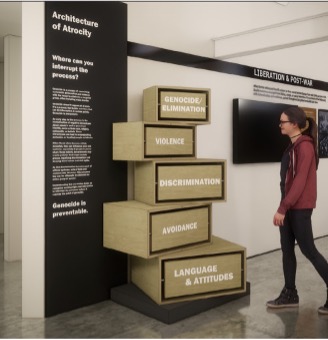
Seattle’s Holocaust Center for Humanity Wall of Atrocity – Architecture of Atrocity
While Rule Two emphasizes survivor testimony, Holocaust museums also avoid drawing direct comparisons between genocides or linking the Holocaust explicitly to current events. Instead, they focus on teaching the patterns of behavior and the decision-making that make genocide possible. The United States Holocaust Memorial Museum (USHMM), explains in “Why Holocaust Analogies are Dangerous”:
Careless Holocaust analogies may demonize, demean, and intimidate their targets. But there is a cost for all of us because they distract from the real issues challenging our society, because they shut down productive, thoughtful discourse. At a time when our country needs dialogue more than ever, it is especially dangerous to exploit the memory of the Holocaust as a rhetorical cudgel. We owe the survivors more than that. And we owe ourselves more than that. USHMM
Instead, these institutions prioritize teaching key terms (and foils) such as bystander versus upstander and victim versus perpetrator. They emphasize genocide as a process, and the everyday choices that made genocide possible. A representative for the Florida Holocaust Museum emphasized their desire to be “a strictly educational institution” and discuss “genocides in general.” A Houston rep explained it’s not about “singling out certain groups, and [rather] just having a more thematic conversation.”
This abstraction itself is strategic. It allows these museums to avoid “drawing the line.” Instead, they give visitors tools to recognize patterns. Visitors are invited to connect past and present, but the institution rarely does it for them. A Seattle representative explicitly said visitors can “look out in the world and see those warning signs […] and connect those dots where we might not be able to explicitly say.”
By focusing on patterns rather than parallels, museums avoid false equivalences and politicization. At the same time, they still fulfill their educational mission by giving visitors the tools to interpret events on their own.
In this way, Rule Three reinforces broader institutional goals: to educate about genocide without prescribing specific conclusions. Rather than drawing explicit connections, museums equip visitors with interpretive frameworks, often by shifting where those conversations take place.
Rule Four: Move Controversy Outside the Exhibit
These rules aren’t meant to prevent expansions. Museums do engage current events and political issues, but not primarily in core exhibitions. These rules help protect the specificity and memory of the Holocaust, but allow museums still to engage with contemporary issues. Rather than addressing controversial current events directly within permanent exhibitions, museums often rely on alternative platforms such as press statements, digital resources, public programs, and temporary exhibits. These spaces provide greater interpretive flexibility, allowing institutions to respond to unfolding events, condemn acts of hatred, or facilitate discussions about contemporary violence without altering core exhibitions that require long-term scholarly framing and institutional consensus. However, relocating controversy does not eliminate it. Instead, it shifts where and how responsibility operates. Museums remain accountable for how they engage the present, but they do so in ways that preserve the Holocaust as their central historical focus.
In this way, Rule Four completes the pattern: rather than avoiding difficult topics altogether, Holocaust museums carefully manage their placement, balancing relevance with restraint.
These rules help Holocaust Museums protect historic specificity, avoid flattening distinct histories, and maintain institutional credibility, while also addressing a central challenge: how to create space for engagement with contemporary issues under strict interpretive constraints. They do, however, limit a direct engagement with present crises. There is a clear tension between clarity and caution, and between relevance and responsibility. Holocaust museums do not draw the line between past and present; they train visitors to recognize where and how to draw it themselves.
By Anya Lord
Max Sarason Endowed Fellow

Anya Lord is a second-year M.A. student in Museology at the University of Washington’s iSchool. Her current research project explores how holocaust museums in the U.S. respond to the challenges of representing holocaust memory. Specifically, Anya is examining the intersection of discourses related to genocide, civic engagement, and contemporary politics. She is especially interested in specific and local interpretive strategies holocaust museums use to engage the public, approaches that typically strive to be ethnically responsible, historically grounded, and emotionally resonant. Anya holds a B.A. in art history, with minors in history and educational studies from Carleton College. When she’s not work, she can be found reading sci-fi and fantasy books, drinking Dr. Pepper or watching “bad action flicks” with her cat.

![Muestros Artistas [Our Artists]: Bringing Sephardic Art and Community Together at the UW](https://jewishstudies.washington.edu/wp-content/uploads/2023/08/UWJS_Muestros-Artistas-cropped-500x383.jpg)