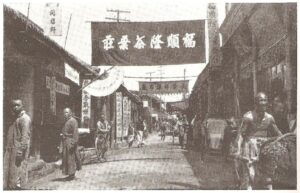
Picture of East Market Street in Kaifeng
By Micah Sprouffske
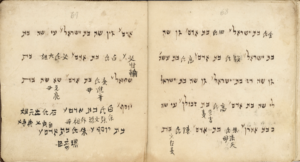
HUC’s Memorial Book Codex Ms 926 written in Chinese and Hebrew. The Codex also provides examples of Chinese words written in Hebrew Script.
The early Jews in China could be compared to Jews living in the United States, from the primary colonies through the early 2000s. Just as the United States historically has been a place of opportunity for Jews, offering a chance to flourish with limited threat from the outside community, so also was China. The Jews, by their own record, first settled in what would become China during the Han dynasty (206BCE-220CE). Of the recorded massacres in Chinese history, most targeted all the others in certain communities, and most were during periods of unrest, particularly during the upheaval of the Five Barbarians between 304 and 316CE. During the Tang Dynasty (607-960 CE), foreign merchants were targeted in a massacre in Guangzhou, which is estimated to have killed tens of thousands. The Guangzhou massacre is the only massacre recorded that specifically mentions that Jews were also killed. During the Song Dynasty (960-1279), through special invitation of the emperor, the Jewish community established a synagogue in Bianliang (historical Kaifeng), then capital of the Song. From the Song dynasty until the advent of Western influence, there is no other indication that the Jewish populations scattered across China were directly targeted as a people. Like most Jews in the diaspora, the Jews who settled in China learned the language of the local population, integrated into society, married converts, and many prospered.
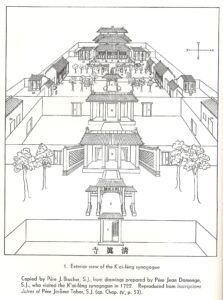
Exterior drawing of the Kaifeng Synagogue, drawn in 1722 by Pere Jean Domenge and featured in the book Chinese Jews (1966) by Bishop William Charles White, Wikimedia Commons
In 1489, the Jewish community of Kaifeng survived a devastating flood and rebuilt their synagogue. To commemorate the event, a stele, a standing memorial stone, was erected in the synagogue courtyard. The stele is described as outward-facing because, being written in Chinese and placed in the outer courtyard, it was intended to be understood by a Chinese audience. A political move of synchronization in a time when China was still recovering from the foreign-ruled Yuan Dynasty (1271-1368). By then, the synagogue could trace its own history back more than three hundred years. It is from these public stele that synchrony can be seen; a synchrony with the sole purpose of aligning religious belief with the “political” atmosphere of the Ming dynasty (1368-1644). Their goal was to gain acceptance among the local populace by deliberately situating Jewish history within a Chinese context. Acceptance and assimilation, a means to security and lasting prosperity.
The most significant piece of direct synchrony, demonstrating the steps taken by the Jewish community to be accepted, can be found in the 1489 stele’s translation of Jewish biblical events: “in the 146th year of the Zhou dynasty, Abraham founded Jewish practices, and in the 613th year of the Zhou dynasty, Moses examined the veracity of the practices and wrote them down for continuation.” The distance between Abraham and Moses can be calculated as approximately 467 years, close enough to not be a problem. The synchrony here lies in the identity of the Zhou dynasty. The Zhou dynasty lasted from 1046 BCE until 256 BCE, but is divided into two periods: the earlier Western Zhou (1046-771 BCE) and the later Eastern Zhou (771-256 BCE). Some commentators on the Kaifeng community tried to rationalize how the dates could be in such error, for Jews surely could not be ignorant of how ancient their history is. The Zhou dynasty runs from about the time of the rule of King David and extended through the Babylonian exile and the eventual return. So why is there a discrepancy, and how could the Jews who settled in Kaifeng be in such error about their own history?
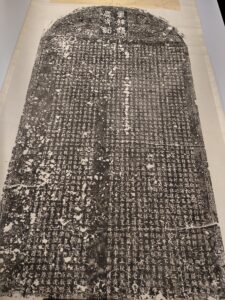
Rubbing of 1489 Kaifeng Stele from the Tateuchi Library
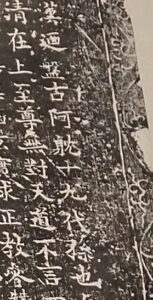
Close up of Kaifeng Stele, emphasis on Pangu Adam
The Zhou dynasty was treated as a historical “golden age” in Chinese traditions, and the early philosophers all harkened back to the Western Zhou as being the ideal. The preceding dynasty, the Shang (1600-1046BC), according to historical annals, grew depraved and corrupt and had to be overthrown by the Zhou. Moses lived during the Shang dynasty. In China, to state that the practices you followed originated during the Shang dynasty would not have been viewed highly. Therefore, it is far better to have Abraham establish the practice during the Western Zhou and then have it revisited by Moses during a period known as the Hundred Schools of Thought, which is when Confucius, Laozi, and many other Chinese philosophers were writing and discoursing. This synchronization was not an error on the Jewish community; it was a political move, providing the Jews with legitimacy in the eyes of Chinese Philosophy.
In following the first step of synchronizing a timeline of events, consciously, the Jews sought connections with other historical figures of Chinese history. One such instance is visible with the phrase 盤古阿躭, pángǔ-ādān. 阿躭, ādān, is considered to represent Adam, but 盤古, pángǔ, is the Chinese primordial man. Pangu is not the only creation type myth that exists in China, but it is the one that the Jews identified with Adam. Pangu emerges from an egg in the void, the upper half of the shell becomes the heavens, and the lower half of the shell becomes the earth. Pangu stretches tall between the heavens and the earth and pushes them apart. Eventually, Pangu dies, and in his death, each aspect of him becomes a different aspect of the world; his fluids become the fluids of the world. His hair, the foliage, and the fleas upon his body, the animals. Paul Carus, the American philosopher credited with introducing Western audiences to Asian philosophies in the early 1900s, likened the myth to that of Tiamat of the ancient Near East. Since then, Chinese scholars have worked to prove that Pangu is an indigenous myth to China, but none of the research, from this author’s perspective, fully eliminates the possibility of a link between the Mesopotamian Tiamat and Pangu. The point here is not whether Pangu is or is not of Chinese origin, but that the Jews saw a connection between Pangu and Adam and aligned the names. Tehom, תהום, the Hebrew word for abyss, used in the creation story before God begins to create the world, is said to be from the same Semitic root as Tiamat. In the Talmud, Hagagiah 12a:2-3 and Sanhedrin 38b:7-8 both state that Adam stretched from heaven to earth and that it was after sin that he shrank. These ideas could not have been unfamiliar to the Jews who settled in China. Between Tiamat and the Talmud, Pangu is not far off from Adam. The Jews of China accepted this similarity and paralleled Pangu alongside Adam.
Synchronization was a tool of security; it was a first step of assimilation, not a denial of their beliefs or practices, but an opening up of their identity as a people of China. Eventually, the process of assimilation slowly diminished external distinctions between the Jewish community and the Chinese. By the 1800s, for unknown reasons, the Jewish community could no longer afford the upkeep of their synagogue, and even though they persisted in trying to receive aid from Jews in the West, the synagogue was eventually sold, and practices moved into the private home.
Micah Sprouffske is a second-year Ph.D. student in Asian Languages and Literatures at the University of Washington, with an emphasis in Chinese linguistics focusing on the evolution of orthography and dissemination and use of Chinese characters to represent the phonologies of borrowed words. He completed his B.A. in anthropology, Chinese, and linguistics at the University of Oregon in 2011, focusing his educational pursuits on early writing systems, in particular working with Mesoamerican scripts and east Asian languages. He worked on an M.A. at Wuhan University in China in Chinese historical linguistics, where he studied early Chinese dictionaries and the historical perspectives of their own written evolution. Currently, he is interested in the linguistic adoption, by the Jewish immigrants to China during the Tang and Song dynasty, of Chinese characters to represent not only the transcription of Hebrew names and terms, but the selection of the characters used to directly represent Jewish ideals within a Chinese context, many of which appear to be directly adopted from the local Daoist tradition.
When not pursuing research, Micah spends his time working in education to support underprivileged youth. He conducted research in conjunction with Haifa University in language education in Haifa schools between 2022 and 2023. Micah has a passion for encouraging language education both for youth and adults alike as language helps bridge cultures. He especially encourages and is interested in the language education and preservation of endangered and decayed languages, where revival is hindered by limited community or a lack of resources.