By Toni Heilman
When I began working at the Stroum Center for Jewish Studies, I was very far removed from my Jewish culture. As a young child, I was very involved: I enthusiastically attended services, learned the Hebrew letters, and engaged with my Sunday School and Hebrew School classes. I have always been a lover of history, and my very first area of interest was the Holocaust. However, all of that ceased not long after my Bat Mitzvah, as my interests evolved into other things. I grew more interested in the English Reformation and the history of Catholicism and would eventually go to college where I majored in history. In my studies, I chose to concentrate on the English Reformation, even taking four semesters of Latin as my foreign language. With all of my focus going solely to my research interests, my own culture and religion were no longer a priority in my life and fell by the wayside. I still identified as Jewish, but I could sooner answer esoteric questions about 16th-century Catholicism than the symbolism of Shabbat.
Upon entering graduate school as a library science student, my mother was the force that eventually pushed me back toward Jewish culture. She encouraged me to introduce myself to Rabbi Lauren Kurland at University of Washington’s Hillel. Upon learning of my personal background and academic interests, introduced me to the Stroum Center so that I could potentially assist with the “Sephardic Treasures” project. I could not have known at that time how accepting this offer would totally change my life— personally and professionally.
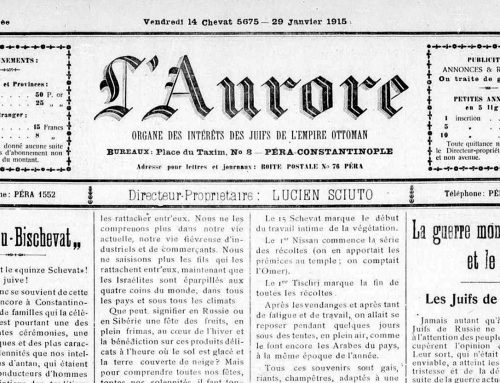
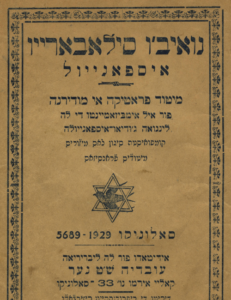
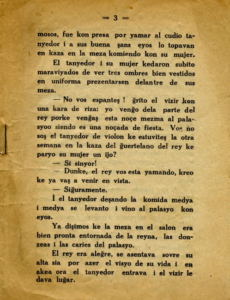
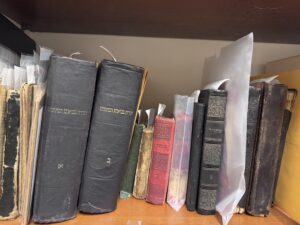
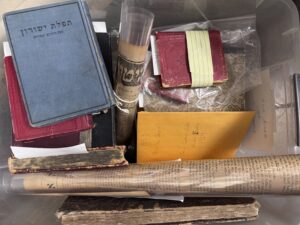
My first major pro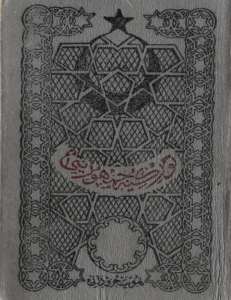 ject while working at the Stroum Center required me to get intimately familiar with the Sephardic Studies Collection. I spent hours organizing the collection housed in Professor Devin Naar’s office. That meant spending a lot of time paging through hundreds of individual items—books, letters, and other materials. I became immensely interested in these items, smiling when I recognized old stories and prayers I had heard countless times as a child. I found myself thanking my younger self for taking my learning of the Hebrew alphabet so seriously, as it was vital to my work as I tried to decode the titles of Ladino books printed in Hebrew letters. Despite being Ashkenazi, I resonated with many of these items as they directly paralleled the culture I had experienced growing up.
 This personal connection only increased as I moved on to transcribing the audio recordings of oral histories collected as a part of the Spanish and Portuguese Citizenship Oral History Project initiated by Professors Rina Benmayor and Dalia Kandiyoti (who, coincidentally, were featured guests at the Ladino Day in 2025). I spent hours listening to rich family histories, researching some of their words to ensure proper transcription, and learning about the history of the Sepharadim. Every audio brought a new story, and I was always so excited to learn more. One particular story from Liz Levine ended up hitting very close to home, and through her I learned that I am entitled to German citizenship. My sister and I are still working through the long bureaucratic process, but we hope to have all of the paperwork submitted by the end of this year. It was during this period of transcription that I attended Friday services for the first time in almost 10 years, and I even attended High Holiday services for the first time ever.
It is not an understatement to say that accepting a role at the Stroum Center has shifted the course of my life in more ways than one. I feel closer to my culture and faith than I have been since I was a child. Additionally, I have secured and am about to begin a position as an archivist at the Nebraska Jewish Historical Society. I cannot say if the rest of my career will revolve around stewarding Jewish history. It remains the fact that I am often easily fascinated by anything historical, and I enjoy the thrill of exploring new areas. However, at this time, I am ecstatic to be able to continue diving into the history of my culture in ways I never thought I would.
Thank you to everyone at the Stroum Center for giving me this opportunity. In many ways, I am sad to leave a position that has had such a positive effect on my life, both personally and professionally. However, I am happy to say that my future looks bright, thanks in large part to the experiences I have had at the Stroum Center.
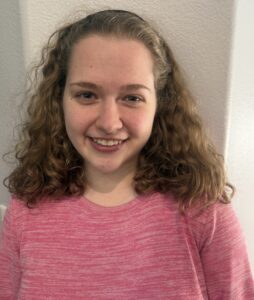 Toni Heilman is a second-year graduate student in the Masters of Library and Information Science program at the University of Washington. Born in Las Vegas, Nevada, she obtained a bachelor’s degree in history at Miami University of Oxford, Ohio in 2024.