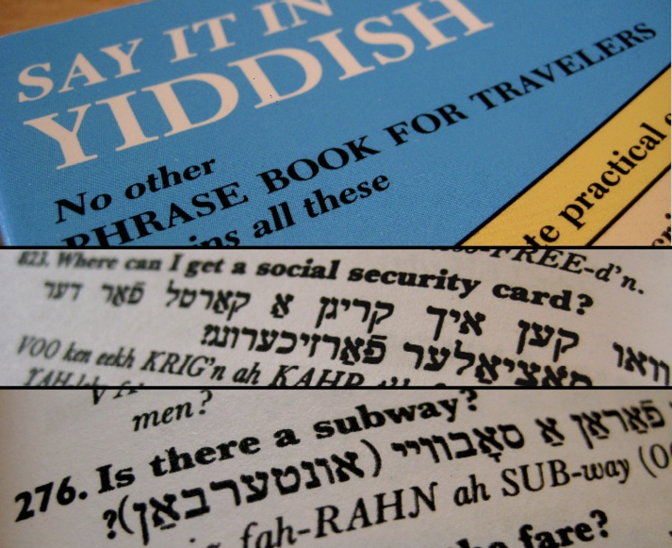
Portions of the phrase book “Say It in Yiddish” by Uriel Weinreich. Photo courtesy of Angus McDiarmid/Flickr.
by Madison Morgan
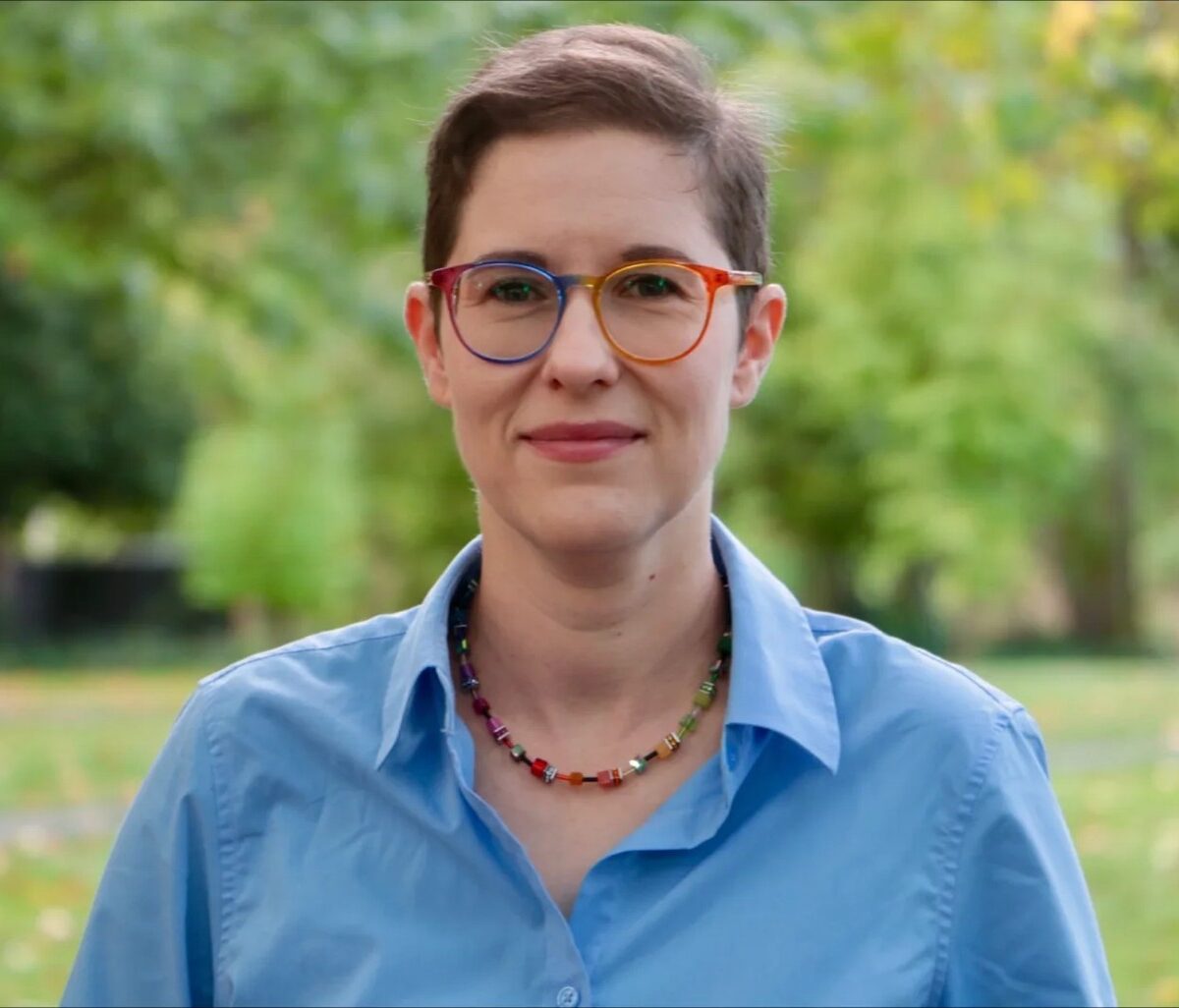
Annegret Oehme was writing a paper on a Middle High German romance when she stumbled across a footnote referencing a Yiddish text about King Arthur’s Round Table.
“I had a background in Jewish and German studies and was super hyped, but equally confused, to read about a Yiddish tale about King Arthur,” Oehme, an associate professor in the Department of German Studies, said. “That footnote became the starting point for my scholarly career.”
Rafael Balling, an assistant professor also in the Department of German Studies, had a different entry point. As a native German speaker who could read Hebrew, he encountered Yiddish while in college.
“Once I started with Yiddish, I really didn’t want to stop,” he said.
Both scholars found in Yiddish a literature that challenged their assumptions — Oehme about the language’s medieval roots, Balling about its contemporary possibilities. Oehme now specializes in Old Yiddish literature, pushing back against the notion that Yiddish is an exclusively modern language.
“Yiddish has been around for more than 800 years! People often look at me in confusion when I use ‘medieval’ and ‘Yiddish’ in the same sentence,” she said.
Balling’s work examines how Yiddish continues to evolve, particularly in queer and trans spaces.
“Yiddish is a lived language, and as any language, it also changes,” Balling said. “For instance, in queer and trans spaces, people have begun to create new grammatical options to make the language more inclusive for gender-diverse people.”
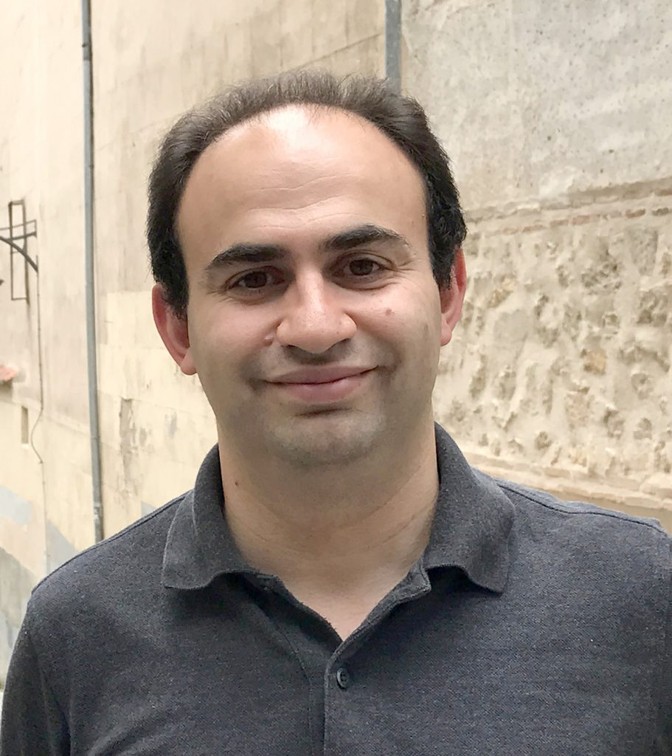
Sasha Senderovich, an associate professor of Jewish Studies and Slavic Languages and Literatures, came to Yiddish seeking access to histories unavailable elsewhere. His great-grandmother — born in Ukraine before the 1917 Revolution — likely spoke the language to him as a child in central Russia, according to Senderovich. However, he didn’t fully dive into studying Yiddish until graduate school.
“Yiddish … opens up a world of political arguments, artistic experiments, and everyday experiences that we can’t fully understand through Russian-language sources alone,” Senderovich said.
Translation has become central to how Senderovich engages with Yiddish literature. He is currently working with University of Illinois at Urbana-Champaign Professor Harriet Murav on the first complete English translation of Itsik Kipnis’s novel “Months and Days: A Chronicle,” which intertwines a young couple’s marriage with the pogroms of 1919 in Ukraine.
“I want readers to encounter writers as distinctive literary artists, whose choices about language, voice, and form shape how we understand the history they lived through,” he said.
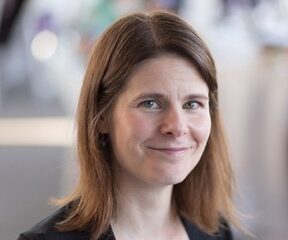
Slavic Languages and Literature Associate Professor Barbara Henry approached Yiddish through theater, drawn initially by songs and later by the work of Yiddish actors. She is translating the memoirs of Avrom Fishzon, who remained in Russia after the tsarist government banned Yiddish theater in 1883.
For Henry, she wants to dismantle the idea that Yiddish belongs only to those who are Jewish.
“No one is surprised that a person of, say, Irish background develops a love of Slavic literature, or a person of Mexican heritage is interested in Korean culture,” she said. “These are all world-class cultures that should be of interest to everyone, and the same goes for Yiddish. Let’s not gatekeep the joy, richness, and beauty of Yiddish culture.”
That sentiment — that Yiddish is misunderstood and dismissed — is nothing new.
“For most people, Yiddish is synonymous with things that are funny and/or a language that is forever-dying,” Senderovich said. “Neither is true and I wish more people understood that.”
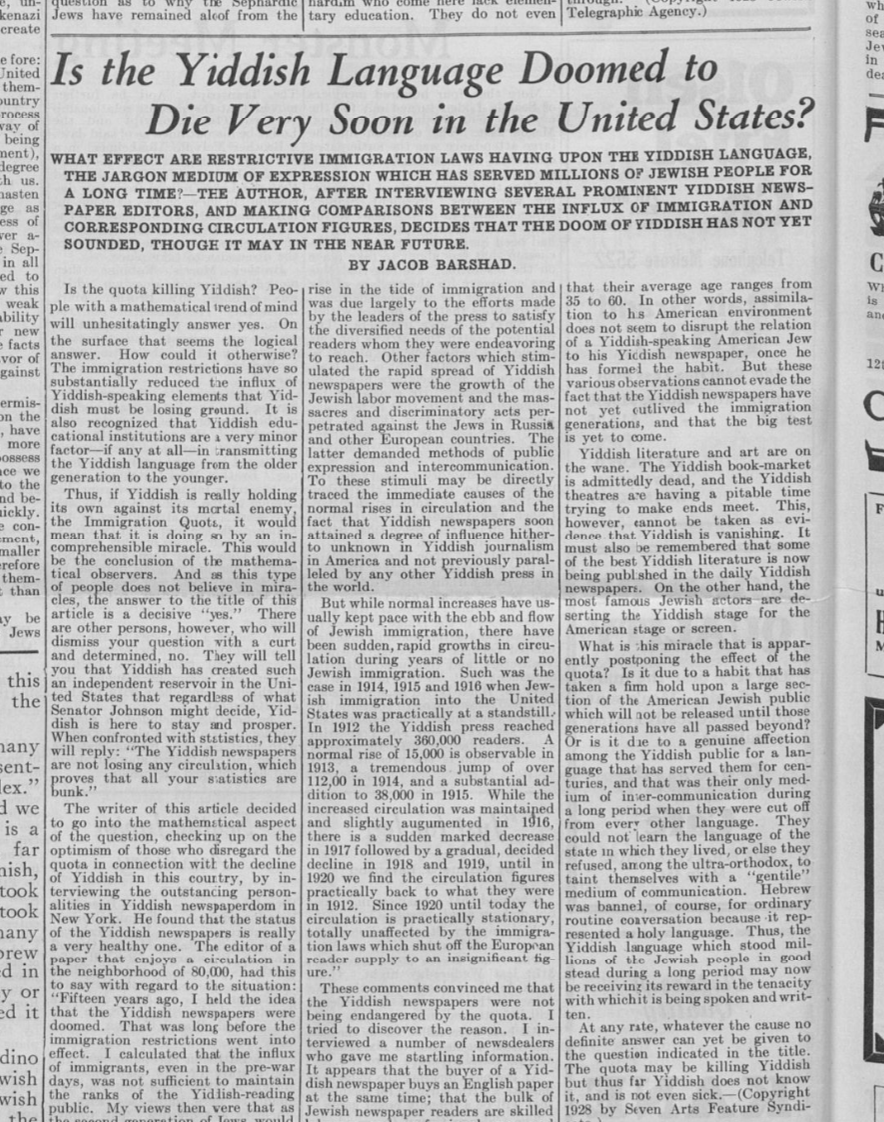
In March 1928, The Jewish Transcript, a Jewish community newspaper based in Seattle, ran a headline asking, “Is the Yiddish Language Doomed to Die Very Soon in the United States?”
Nearly a century later, Senderovich notes the opposite, seeing growing excitement about Yiddish as a language of Jewish diaspora, especially among younger Jews.
“They’re looking for ways to ground Jewish belonging in language, literature, cultural creativity, and solidarity with their neighbors,” he said. “Yiddish offers a rich, contentious history through which to explore those possibilities.”
All four scholars credit the Stroum Center with creating space for their work through funding, speaker series, and intellectual community.
And since 1975, the annual Stroum Lectures have hosted scholars whose work reshaped Jewish studies — including Yiddish scholar Anita Norich, whose 2006 lectures culminated in her book on Yiddish translation, and singer Anthony Mordechai Tzvi Russell, who performed Yiddish music in 2023.
That institutional support now reaches the next generation of students learning Yiddish at the UW.
“The students I meet who are interested in Yiddish give me hope,” Oehme said. “Yiddish is alive and thriving, and I hope we can build on that energy here, too.”